

Forget the proverb ‘opposites attract:’ A massive Swedish study suggests that men and women who have a psychiatric condition such as autism, schizophrenia or attention deficit hyperactivity disorder tend to pair up with people who share their diagnosis1.
This nonrandom mating pattern, described 24 February in JAMA Psychiatry, may help to explain why these psychiatric conditions often run in families, says lead investigator David Mataix-Cols, professor of clinical neuroscience at the Karolinska Institute in Stockholm, Sweden.
It may also clarify why certain psychiatric conditions seem to share genetic risk factors. Partners who have different psychiatric diagnoses may have children with an increased risk of both conditions, Mataix-Cols says.
A few small studies have hinted at nonrandom mating patterns among people with psychiatric conditions. For example, a 2005 study found that men and women with autism-like symptoms tend to partner and have children who have even more of these symptoms2. But a 2007 study that used a different measure of autism symptoms failed to turn up the same pattern3.
The new study, which is based on people with diagnoses rather than just symptoms, suggests that nonrandom, or ‘assortative,’ mating is widespread, not only among people who share the same diagnosis but also among people with different psychiatric conditions.
“I think this is a major scientific contribution,” says John Constantino, professor of psychiatry and pediatrics at Washington University School of Medicine in St. Louis, who led the 2005 study but was not involved in the new work. “It has enormous implications for understanding the genetic structure of psychiatric conditions and how they’re transmitted across generations.”
Family affairs:
Using the Swedish National Patient Register, a repository of medical diagnoses in Sweden since 1973, Mataix-Cols and his colleagues identified more than 707,000 people diagnosed with any of 11 psychiatric conditions or 5 nonpsychiatric ones, such as diabetes.
The group included more than 26,000 people with autism, 60,000 with attention deficit hyperactivity disorder and 70,000 with schizophrenia. (The other psychiatric conditions include bipolar disorder, anorexia nervosa and generalized anxiety disorder.)
For every diagnosed individual, the researchers included five age- and gender-matched controls who reside in the same county. They used marriage records or birth certificates to identify opposite-sex partners for each individual; the National Patient Register revealed whether these partners have any psychiatric diagnoses.
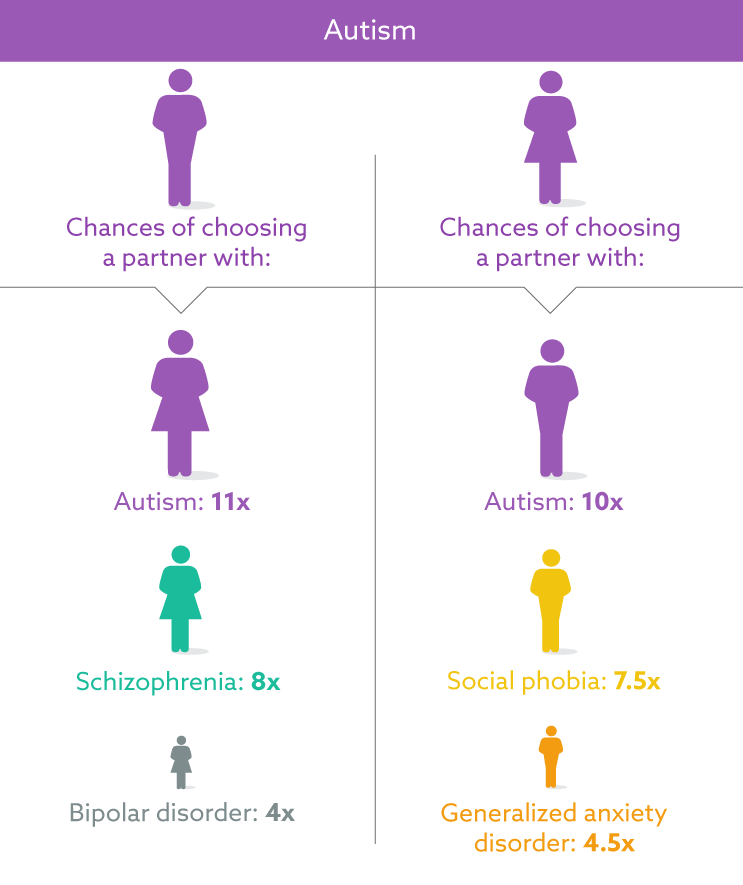
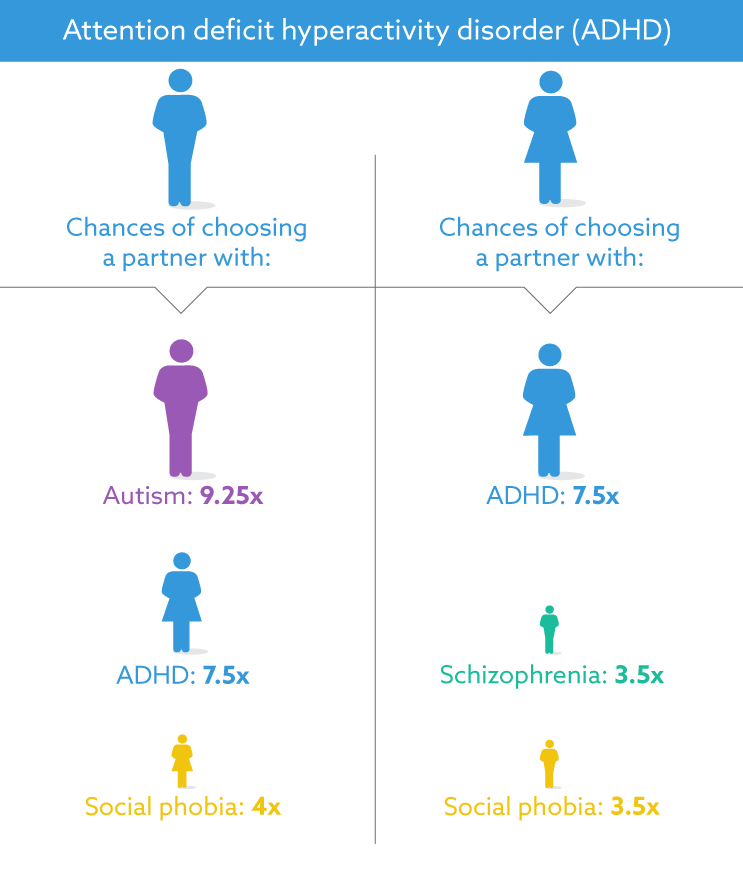
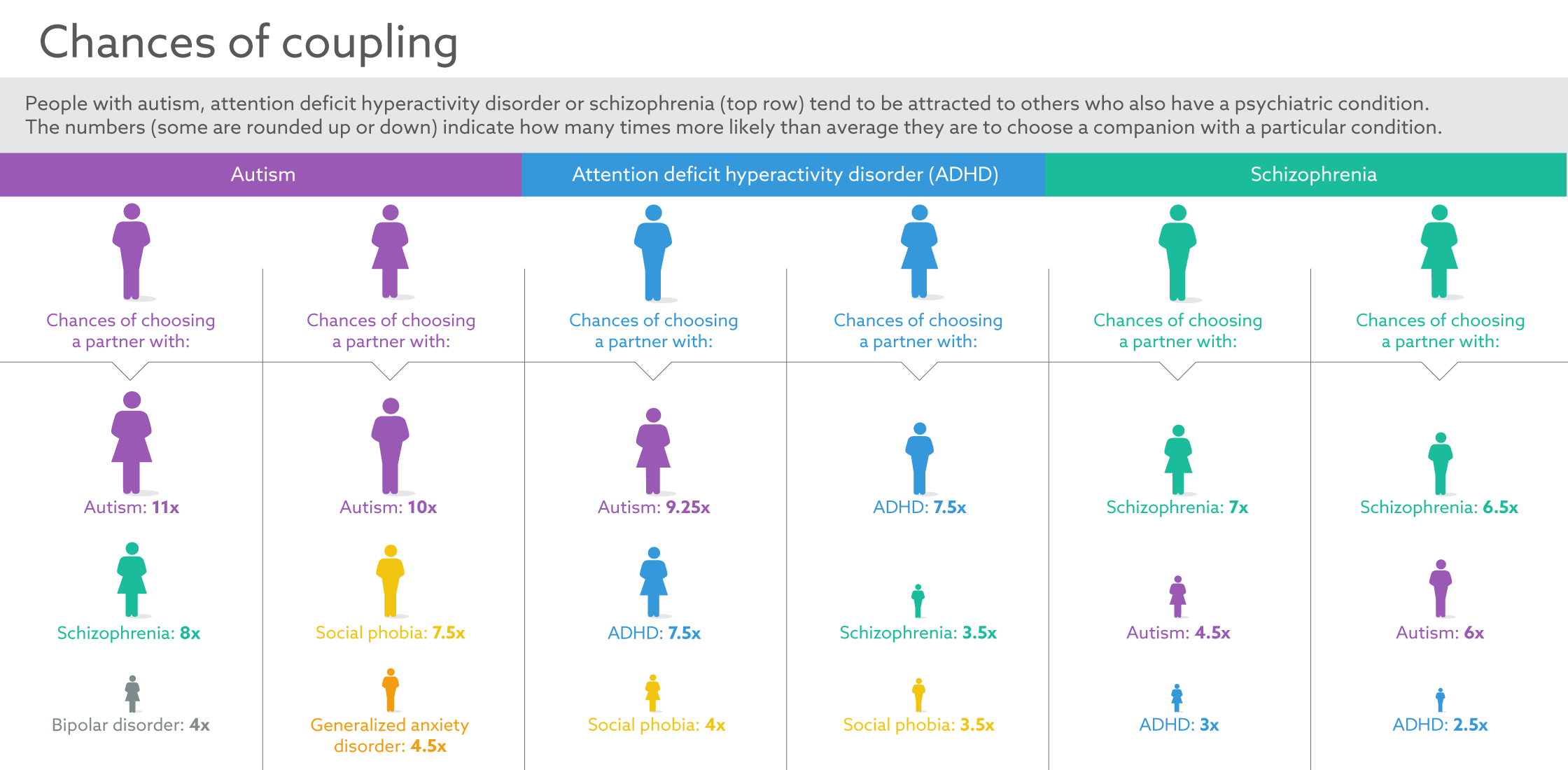
The researchers found that people with each of the psychiatric conditions are more likely than their matched controls to couple with someone who has the same diagnosis. This pattern is more apparent among couples with autism, ADHD or schizophrenia than in those with any of the other conditions.
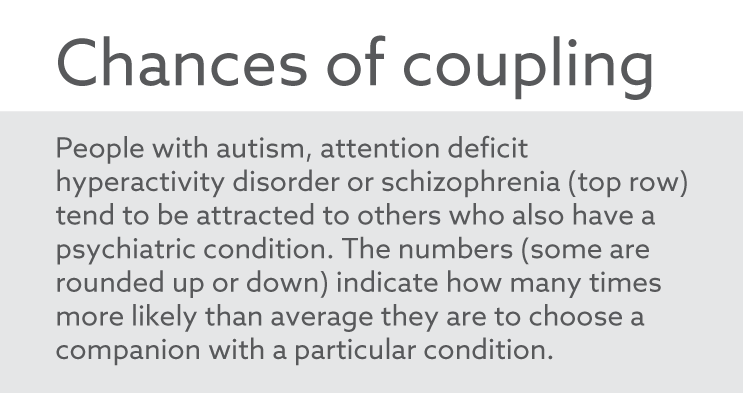
Nonrandom mating occurs across different conditions, too, although people with different diagnoses are slightly less likely to pair up than those with the same condition (see graphic below). Overall, people with any of the psychiatric conditions are about three times more likely than controls to pick a partner who also has a psychiatric diagnosis.
By contrast, nonrandom mating patterns are weak among people with any of the nonpsychiatric conditions. Only people with multiple sclerosis showed a slight tendency to pair up with a person who shares their diagnosis.

Genetic puzzle:
The findings for autism are preliminary because few participants with autism — 880 men and 975 women — got married or had children.
A large proportion of people with autism in the study — 22 percent — were under 20 years of age, and so unlikely to be married or have a child yet. And some individuals with autism do not find a partner at all, says Rosa Hoekstra, assistant professor of psychology at King’s College London, who was not involved in the study.
“The people who are in successful relationships and have kids will not be the very severely affected people with autism who have severe intellectual disability,” she says.
For those individuals who do find partners, the findings call into question the assumption that these individuals choose a mate at random, statistically speaking, says Ashley Nordsletten, a postdoctoral fellow who works with Mataix-Cols. Not accounting for nonrandom mating in the analysis of study data may underestimate the contribution of genes to a condition, Nordsletten says.
This problem may be less significant in autism, for which estimates of the impact of genes are as high as 95 percent. “So it’s not like researchers have been badly underestimating genetic influence in autism,” Constantino says.
Still, researchers should acknowledge the possibility of nonrandom mating across psychiatric conditions when looking for potential risk factors for autism, Hoekstra says. “Autism doesn’t stand on its own; it’s part of a much bigger range of psychiatric conditions,” she says. “It might be worth looking at it from this broader perspective when we’re looking at causes.”
The post People with autism prefer partners on the spectrum appeared first on Spectrum.


