

“Vibrant waves of sequenced patterns emerged in my head whenever I looked at musical notes and scores. Like pieces of a mysterious puzzle solved, it was natural for me to see music and its many facets as pictures in my head. It never occurred to me that others couldn’t see what I saw.”
By Stephen Shore
When I was a child, music, laughter, and a conscious focus on my abilities filled our home. The radio, always tuned to classical or popular music stations, encouraged singing, movement, and playful narration. My parents, who were quite progressive for the times, defied the conventional wisdom of the mid-1960’s; that I be institutionalized. Instead, they were determined to provide me with a foundation that emphasized music, creativity, movement, sensory integration, narration, and imitation. In today’s terms, we would call their efforts an intensive home-based early intervention program, probably most closely related to the cognitive-developmental systems approach called the Miller Method.
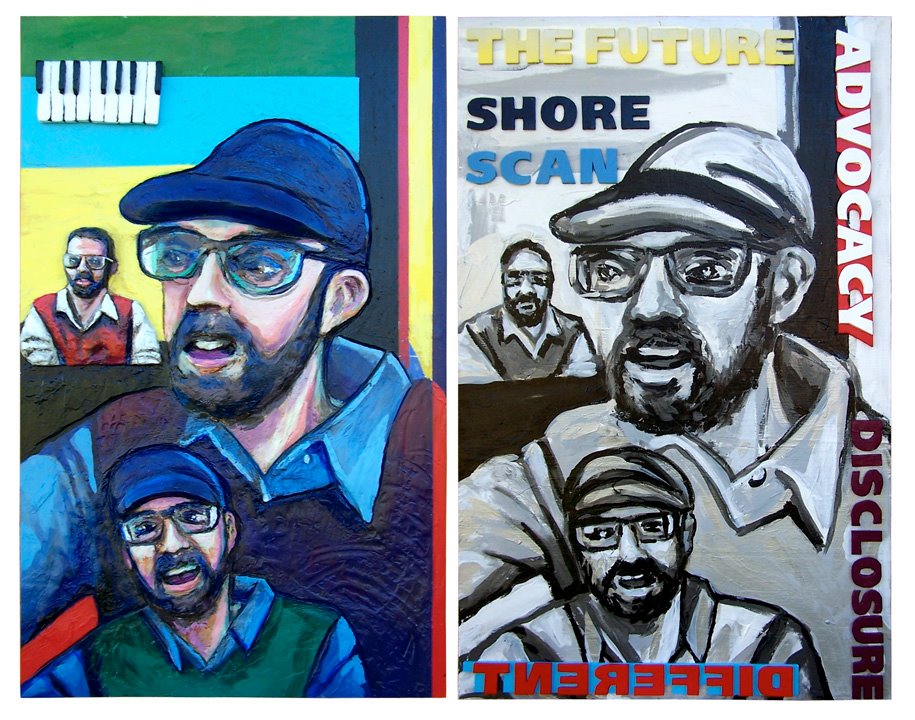
Artist Steve Selpal's rendition of Stephen Shore
My parents saw me as having an extremely diverse skill set with great potential to emerge my odd, if not quirky behaviors. They reasoned that in emphasizing my strengths, they could reach me in my isolation through creativity and intention. Their focus on awakening my spirit and abilities is what I suspect drives me to teach music to children with autism today. I believe my connection to music mirrors why many of us are involved in the arts: to give those on the autism spectrum, as well as persons viewing or enjoying their art, a greater appreciation for what it is to be human.
Today, in addition to traveling the world and sharing my methods, I teach at the university level, write books and articles on autism, and give music lessons solely to people on the autism spectrum. I consider myself a music educator, not a trained music therapist, yet my work helps achieve several therapeutic results, including improved motor control, communication, and social interactions. In giving a person on the autism spectrum a solid key through the arts, they are enabled in a relaxed environment to develop interactions with others. The learning of artistic theory and craftsmanship is always secondary to participating in the process, which develops self-esteem and an appreciation for others.
In recent years, an explosion of the popularity of the arts as interventions in autism is apparent. There is no doubt that parents and professionals who use the arts as specific and intentional tools are likely to achieve significant results in improved empathy, behaviors, and language. Music, in particular, provides an alternate means of communication for those who may be nonverbal, and for others it can assist in organizing verbal communication.
Whether it be music, drama, visual arts, comedy, dance, or other forms of the arts, I encourage parents to “play” in creativity with their kids. While not every child will respond to every form of the arts, within every child is a connection to one form or another and a potential waiting to be fulfilled. Find your child’s artistic “carrot,” and you’ll open a door to possibilities beyond your wildest imaginations and dreams.
***
Dr. Stephen Shore presents and consults internationally on adult issues pertinent to education, relationships, employment, advocacy, and disclosure and is the author of Beyond the Wall: Personal Experiences with Autism and Asperger Syndrome, Ask and Tell: Self-Advocacy, Disclosure for People on the Autism Spectrum, Understanding Autism for Dummies, and the DVD Living Along the Autism Spectrum: What it means to have Autism or Asperger Syndrome. Stephen Shore is a contributor to The Art of Autism: Shifting Perceptions by Debra Hosseini (now Muzikar) (2012).
Dr. Stephen Shore, from “The Art of Autism: Shifting Perceptions,” page 44.


