

“You can conquer anything with Asperger’s and be your own boss to a healthy well balanced life,” Jeremy Samson, creator of Time to Train
By Ron Sandison
Research studies indicates that involvement in athletics and social activities can help children with behavioral issues decrease by 20-25% and also decrease depression and anxiety. Jeremy Samson, a fitness trainer/manager with Asperger’s from Melbourne, Victoria, Australia for three weeks toured the United States teaching his successful program Time 2 Train. On May 12th we both presented at the Navigating Autism Today Conference at the Bavarian Inn, Frankenmuth, MI. I had the pleasure to have lunch with Jeremy and listen to his presentation.
Jean Piaget, the Swiss psychologist who mapped out the stages of children’s cognitive development, believed movement is essential to learning. Piaget stated, “Children learn by physically manipulating objects and seeing how they work.” Time 2 Train helps individuals with autism learn social skills and gain fine motor skills through exercise, athletics and social interaction.
Jeremy has seen amazing results through his personal training program. Children with limited speech ability develop new communication skills; individuals lacking fine motor skills learn to play sports in competitions; and young adults with limited social skills interact with friends.
Below are my questions and Jeremy’s answers.
- How did Asperger’s effect your childhood and teen years?
My childhood years had its ups and downs like many. But I guess my perception towards others and things happening around me felt like I was watching a movie and wanting to connect and be more involved but did not have the confidence, motivation or on some occasions interest to want to participate and be actively involved. My teen years were different as I found myself by then beginning to really feel like I served a genuine purpose to be “good enough” to be involved and try new things.
2. What was your biggest challenges having autism?
For me, trying to understand and comprehend what was going on. I hated that basic things I could not understand and I put so much pressure at times on myself in trying to be as good as others because my mind told me, if they can do things so easily, why can’t I.
- Did you have any sensory issues?
A vacuum cleaner sounded like the scream of a thousand people dying. I could not handle having my food touch each other on my plate as I was of the belief that this would change the outcome of the taste of my food and I did not want to spoil that taste. It took time and understanding to realize that for some dishes it was perfectly okay to have foods touch one another. I also found certain smells to make me feel strong emotions. My sensory system was definitely hypersensitive.
- How were your social skills as a child?
My social skills in the beginning were not so great. I use to jumble my words frequently and believe strongly in my head that what I was saying was correct. So when my mother or anyone tried correcting me. I use to find this frustrating and insulting to my intelligence even though my language made little sense.
- What are some things that helped you to be successful?
Supportive parents, strong routine and a desire to acknowledge that my ability can improve and that I can be as good as anyone if not better. I continued to remain positive through re-enforcement in myself and those around me. I used to seek gratification towards my efforts at home to ensure that what I was doing was the right thing to do.
- What inspired you to create Time 2 Train?
I was inspired after my first family entered into the gym wanting their 12-year old son be trained in losing weight and improving their Asperger’s condition. The idea was simple. Help those like I was helped and work with all ages as best I can to improve in their overall development just like I did myself.
- How does Time 2 Train work?
Time 2 Train uses exercise and activities to focus on building neuroplasticity in the brain by shifting activity to areas of the brain where stimulation is low. Through routine and commitment of this program is showing tremendous improved results in the overall outcome of an individual with Autism/Asperger’s.
- What are some life skills you teach children with autism & Asperger’s?
I teach all kinds of various life skills to the students. From improving in areas such as confidence in themselves; how to adapt to different environments; managing and coping mechanisms; learning to be mindful of others in different social scenarios. Anything I see in a student I feel they are lacking or not understanding is an area I am quick to teach because I believe that all individuals with Autism/Asperger’s can be positively involved in the wider community.
- How does Time 2 Train help children with sensory issues?
Time 2 Train helps stretch the minds and abilities of those with Autism/Asperger’s through exercise which helps them to understand and realize that if they can improve in themselves through physical exercise, then why not improve the sensory system. It is all in the minds for these individuals and once they understand that they very much have the capacity to stretch themselves in anything they put their mind on, they will achieve.
- What results have you seen with Time 2 Train?
I have had the honor and privilege to see some truly life-changing results, from verbal communication, to some, no longer needing any further medication. From improving in co-ordination to positive attitude and better overall personality. I continue to see so many successful results from a simple but effective concept in Time 2 Train Personal Training.
- What advice would you give to young people with autism & Asperger’s?
Never think they cannot do something because of their condition. Learn how to listen to others and their advice, whether it is useful or not. Continue to grow and be humble that you have the capacity to learn so much and shape yourself positively to make a better difference in yourself first then your community and those around you. Change and don’t live in fear or regress back to old behaviors. Go forward and make as much of a life as you can with Autism/Asperger’s.
- What did you enjoy most about your visit to the U.S?
I was really pleased to finally catch up with my dear friend Paul who I had not seen since we last saw each other back in 2015 in Vancouver, Canada. I also thoroughly enjoyed seeing all the wonderful iconic locations around the U.S especially in Washington. I also enjoyed meeting families who had loved ones on the spectrum and listening to their stories and helping them out in anyway I could.
- What have you learned from your visit to the U.S?
I have learned so many differences between the U.S and Australia and that there were many Americans that would love to visit or live in Australia as they feel their country in certain aspects are a little to greatly behind in different areas especially health care.
- How is Australia different from the U.S in their therapy of autism?
From what I gathered from my visit is that many are unaware of a more natural approach to helping difficulties with autism and so many are still of the idea that a “pill” will fix everything. Also many therapies are very unaffordable and just not easily financially accessible to so many families. After talking about Time 2 Train with the families I meet they were surprised they didn’t have anything like this back home in their own country.
- Is there anything else you like to share?
I feel it is important to help many understand that it is very possible for someone on the autism spectrum to live and achieve anything and everything if they are willing to first help overcome anxiety and stress through better management of their anxiety. Building greater confidence and acceptance of the condition is paramount and then taking better successful steps forward.
Having Autism/Asperger’s is not a bad, negative thing at all. It does come with its frustrations and challenges yes! But having a negative mind, negative attitude and overall personality because you are unwilling to learn, accept or improve yourself is what hinders so many individuals from reaching their true potential in life. Always learn and get as much life experience as you possibly can.
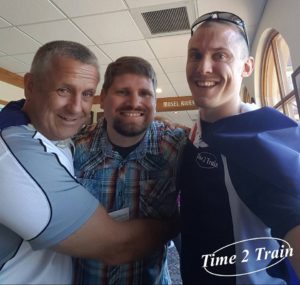
To find out more about Time 2 Train visit these websites:
www.time2trainaspergers.com and www.lupeprogram.com
***
Ron Sandison works full time in the medical field and is a professor of theology at Destiny School of Ministry. He is an advisory board member of Autism Society Faith Initiative of Autism Society of American. Sandison has a Master of Divinity from Oral Roberts University and is the author of A Parent’s Guide to Autism: Practical Advice. Biblical Wisdom published by Charisma House. He has memorized over 10,000 Scriptures including 22 complete books of the New Testament and over 5,000 quotes.
He frequently guest speaks at colleges, conferences, autism centers, and churches. Ron and his wife, Kristen, reside in Rochester Hills, MI, with a baby daughter, Makayla Marie born on March 20, 2016. You can contact Ron at his website or email him at sandison456@hotmail.com


