

Reposted with permission from How To ABA
HRE is a more recent term in ABA that says a learner should be happy, relaxed, and engaged during ABA therapy. But what exactly does happy, relaxed, engaged mean?
What is Happy, Relaxed, Engaged?
Dr. Gregory Hanley states in his paper, A Perspective on Today’s ABA, that individuals with autism learn better through joy. He says that we should have conversations with our learners about what they love and hate, and use that information to create a context in which they feel happy, relaxed, and engaged during their sessions.
This helps them to feel safe and in control. So, our functional assessments need to incorporate practical control periods where students are happy, relaxed, and engaged.
I recently Googled this term in order to give more information to some therapists I work with. And there’s really not a lot of content out there that expands on this terminology. We just assume that everybody knows what happy is, what relaxed is, and what engaged is. But that’s not always the case. So let’s break down those terms.
Happy
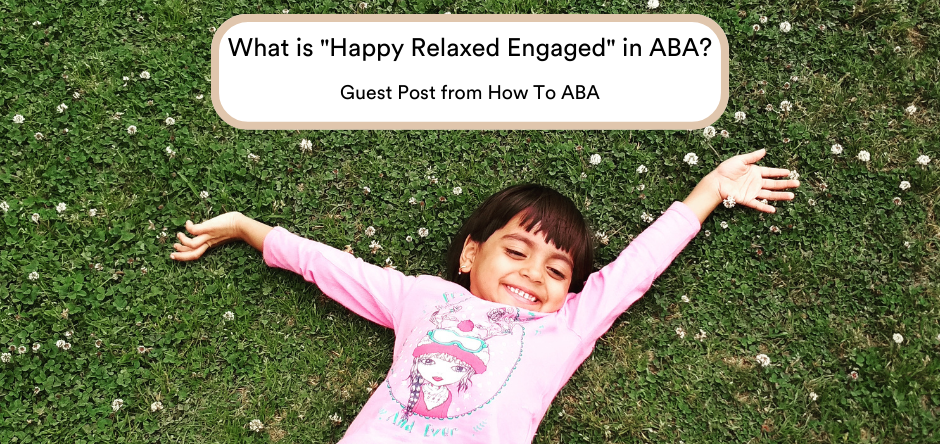
So first of all, let’s look at “happy.” As ABA professionals, we need to get to a place where our student is really comfortable and prepared to learn. What does this look like? They’re content – they may be smiling or laughing – they are definitely not crying or trying to leave the situation. They desire to be in the moment. Period. That’s happy. But sometimes, people can be happy but they’re not always relaxed.
Relaxed
What does “relaxed” look like? The individual is calm and not at all anxious. If you know the Zones of Regulation, they’re in the green zone.
Now, let’s say you have a student that your therapist says is relaxed, but when he’s playing with something he gets really revved up. That’s not actually relaxed. We want the student to be calm, cool, and collected. No anxiety, no precursors to challenging behavior. That’s what relaxed means.
Engaged
Finally, what does “engaged” look like? Actual engagement means participation in activities. If there are toys around and the student is looking at them but not interacting with them (they may or may not be engaging in some stereotypy or self-stimulatory behavior), that is not engagement. True engagement means that your learner is actually interacting with the toys around them. This is also true for activities other than toys. People can be engaged in any part of the environment around them. Maybe they’re engaged with you or with the therapist.
If a student is supposed to be on a movement break, but they’re just standing there doing nothing or engaging in stereotypy, that’s not engaged either. Watch and understand what true engagement looks like for your student and then have a conversation about it with your team so everyone can learn and adjust as needed.
Why is Happy, Relaxed, Engaged Important?
According to Dr. Hanley, when a learner is “happy, relaxed, and engaged,” you can show them that you hear them, see them, and are there for them. He says that a happy, relaxed, and engaged learner is less likely to engage in severe problem behavior, which will allow you to empower them and teach them more challenging skills.
We hope this gives you more insight into HRE.
Check out the How To ABA website for additional resources and free downloads.
About the Authors
Shayna Gaunt, MA, BCBA | With over 20 years in the field of ABA, Shayna is a master program developer. She has a unique knack for finding the practical application of ABA to real-life so that the interventions are doable and successful!
Shayna has been practicing Applied Behavior Analysis (ABA) since 1997. In 2005, after graduating with a Masters Degree in ABA from the University of Nevada Reno (UNR), she was one of the first in Ontario, Canada to obtain her BCBA. She is the Founder and Executive Director of Kid Mechanix, Inc. in Toronto, Canada, where she met Shira Karpel.
Shayna also has international experience, providing clinical expertise and training workshops to clients in Canada, United States, Costa Rica, England, Egypt and Qatar.
Because of her extensive training in a wide variety of interventions over the years, Shayna has a knack for developing unique, practical programs that teach across operants. She seriously thinks in data sheets!!!!
Shayna’s super-power is her ability to explain complex ABA principles in practical, relatable terms. She is a master program-developer and most of what you see in The Bx Resource is her ABA-mind put down on paper. As a member of The Bx Resource, you get the privilege of learning from her and leveraging all that ABA knowledge for your own practice!
Shira Karpel, M.ED, BCBA | As a former teacher, Shira is passionate about spreading the benefits of ABA to more children. She envisions a world where ABA is the go-to, accepted intervention in classrooms and homes everywhere! She is the co-founder of How to ABA which was started to create a community where all BCBAs and ABA professionals can get support and resources so that clients can get the best treatment possible.
Shira has a Masters in Special Education and then went on to pursue her BCBA. With extensive supervision and training (ahem, thanks Shayna!!), she has been working in the field of ABA since 2011. Together with Shayna, they trained, and taught many therapists, clients, and parents and collected a massive bank of ABA programs and resources. One day, the light bulb went off and Shira said, “We should be sharing all of this!” Hence, How to ABA was born!
Her passion is in creating positive, comprehensive learning environments for all students. She loves that with her knowledge in ABA, she can now support teachers in their classrooms. She is the Director of Behavioural Services at a private school in Toronto and is loving getting to make a difference in the lives of children and families daily. She is passionate about making the principles of ABA practical and doable and relevant to every child in any situation.
The post What is Happy Relaxed Engaged in ABA? appeared first on Different Roads to Learning Blog.


