

By Dr. Anton Shcherbakov, BCBA
There are many reasons that kids can experience a delay in speech development. Sometimes it’s because of a neurodevelopment disorder, such as autism or intellectual disability. Other kids may have an oral-motor coordination or hearing problem. Regardless of the cause, there are some simple strategies that can help kids communicate more. Please note, this information is not intended as a replacement for intervention by a trained professional. If you have concerns about your child’s speech or language development, your first step should be talking with your doctor about diagnosis and treatment.
Receptive vs. Expressive Language
Language skills can broadly be divided into receptive and expressive abilities.
Put simply, receptive language is the ability to recognize and understand words spoken by others. Receptive language abilities can be tested by giving a child a simple instruction such as “stand up,” “clap your hands,” or “come here.” The child does not have to respond verbally to demonstrate receptive language ability.
Expressive language is the ability to use words, gestures, and writing to communicate with others. It can also include the use of an augmentative communication device. Expressive language may be tested by asking a child, “What do you want?” or “What’s this?”. There is frequently a discrepancy between what a child can understand receptively and what they can express. For children with Autism Spectrum Disorder, the expressive language repertoire can often grow more slowly than receptive language.
Top Three Tips for Increasing Language Skills
- Start with Simple 1-Step Directions
We almost always start with teaching receptive language before expressive language. Why is that? It is usually easier for children, especially those with speech delays, to start by understanding the vocalizations of others. Producing vocalizations (or gestures) requires significantly more motor coordination. Fortunately, it is pretty easy to start teaching receptive language. In fact, your child may already understand some basic directions already! Some of the first words that most children understand are things like their name and simple directions like “look” and “come here.” You can add to this growing language base by teaching simple directions such as, ”give me,” “clap,” or “wave.”
- Teach Words for What They Like
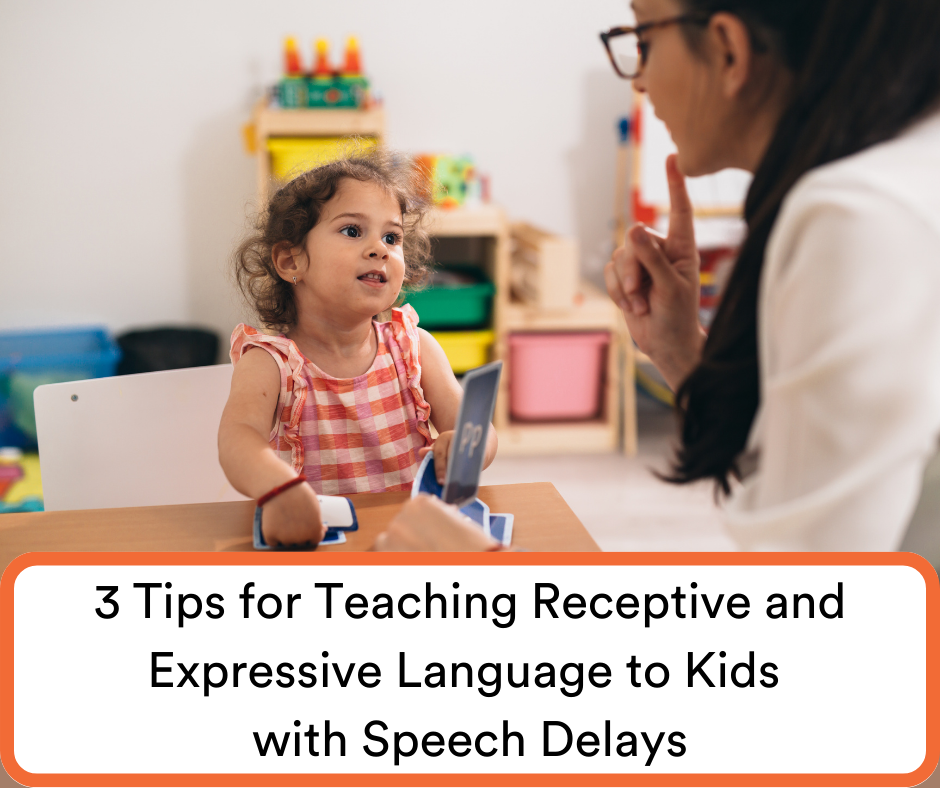
Once a child can follow a few simple 1-step directions, you can begin teaching them to understand the names of objects. Start with objects they like because those are the easiest to learn. Gather 3 of their favorite objects and put them on a table. Then say, “Give me the ball.” If they pick the right object, give a lot of praise (high fives, tickles, etc.). If they make a mistake, give them a gentle prompt by pointing to the object or picking it up and saying “this is the ball!”, and try again. Keep practicing, but keep each practice session short for early learners, just 5-10 minutes at a time. As the child’s vocabulary expands, you can start using pictures in place of physical objects. Why is that? Objects take up a lot of space and it can be hard to gather all the things you want them to learn about (e.g., lions and trees). Having pictures is also less distracting than having the real toy or food item in front of them.
- Teach Requesting Skills
Once a child is able to reliably understand at least 5-10 words receptively, you can begin teaching some expressive language skills. The best way to start is by teaching them to ask for what they want! This is a built-in motivator for speaking. Hold some desired objects like toys and food just slightly out of reach. Prompt the child to name the object with an approximation of the word. For example, “ba” for ball or “ma” for mango. Keep practicing and refining the word so it gets more and more clear over time. Once the child is able to reliably ask for what they want, you can start having them label objects or pictures by holding it up to them and saying “What’s this?”. Provide prompts as needed and don’t forget to praise lavishly. Learning should be fun!
Last but not least, try to be patient! All children learn at a different pace and may need some help and practice to start talking more. Make sure to involve your child’s doctor in the conversation and seek professional help as needed.
About the Author
Dr. Anton Shcherbakov is a licensed psychologist and board certified behavior analyst. He has co-authored peer-reviewed research on topics that include depression and suicide prevention. He is also a nationally recognized expert and frequent presenter at national conferences on the treatment of anxiety, ADHD, autism spectrum, OCD, and related conditions. He previously taught at the Rutgers Graduate School of Applied and Professional Psychology.
Dr. Shcherbakov is the co-founder of ThinkPsych, a company committed to making fun and evidence-based toys for social emotional learning. In addition to his work at ThinkPsych, he provides psychotherapy to children, adolescents, and adults at The Center for Emotional Health of Greater Philadelphia. In his free time, he enjoys traveling with his family, cooking meals with too many ingredients, and watching the latest Netflix documentary series.
The post Top 3 Tips for Teaching Receptive and Expressive Language to Kids with Speech Delays appeared first on Different Roads to Learning Blog.


