


One of my favorite textbooks about ABA is Focus on Behavior Analysis in Education: Achievements, Challenges, and Opportunities. And one of my favorite chapters in that book is called “Building Behaviors versus Suppressing Behaviors,” which focuses on school-wide positive behavior change This is an often-overlooked key concept in behavior analysis that can have a huge impact on the school environment. Furthermore, when we think of ABA, we often think about individual interventions, but the principles of ABA can be highly effective when applied to large environments, such as an entire school.
The chapter references several studies about school-wide behavior change and offers evidence-based practices for achieving such change. It also outlines social behaviors that should be taught, such as how to apologize or how to make a request, then discusses strategies for rewarding the desirable behaviors. I appreciate that it focuses on getting students involved in making such changes.
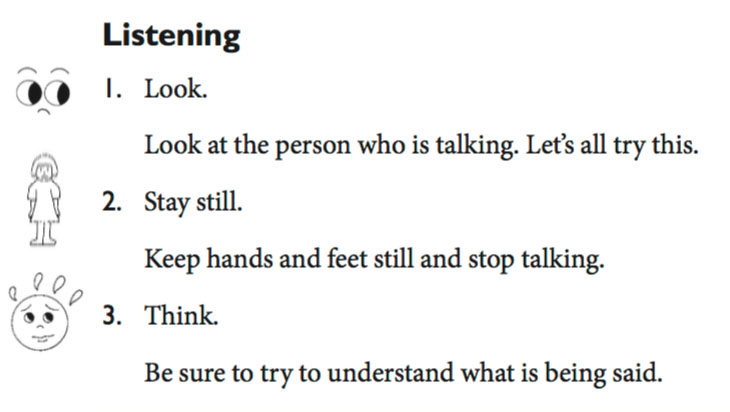
 Teaching these desirable behaviors can often feel challenging with the additional stresses of a special education classroom. One curriculum I have found effective in addressing this problem is Skillstreaming. I often use Skillstreaming in Early Childhood with young learners, and love that it clearly defines desirable behaviors, such as how to listen or how to offer help (see image below), but provides those definitions in simple terms with visual prompts that help our young learners. It also incorporates positive reinforcement for learners who are engaging in those desirable behaviors.
In summary, there is lots of evidence out there that focusing on what kids should be rather than what they should not be doing is beneficial for the learner and the general culture of the classroom. Providing clearly defined desirable behavior and building instruction in those behaviors throughout the day is essential. And that instruction may need to be more frequent and more detailed for our learners with developmental disabilities.
References
Heron, T. E., Neef, N. A., Peterson, S. M., Sainato, D. M., Cartledge, G., Gardner, R., … & Dardig, J. C. (2005). Focus on behavior analysis in education: Achievements, challenges, and opportunities. Pearson/Merrill/Prentice Hall.
WRITTEN BY SAM BLANCO, MSED, BCBA
Sam is an ABA provider for students ages 3-12 in NYC. Working in education for ten years with students with Autism Spectrum Disorders and other developmental delays, Sam has developed strategies for achieving a multitude of academic, behavior, and social goals. Sam is currently pursuing her PhD in Applied Behavior Analysis at Endicott College.


