

Reposted with permission from Ashleigh Evans, MS, BCBA
Visual supports are items used as prompts/cues to help guide one toward the expected behavior. Visual supports are not exclusive to children with autism. Even as adults, we all use visual supports, from our planners to organization apps and more.
Visual supports can be beneficial in reminding children of the expectations and guiding them through adaptive behaviors.
We’ll review a few common visual supports. If your child is receiving treatment, chat with their care team about implementing the most appropriate visual supports for your child. It’s easy to get carried away with all the visuals, but that can get overstimulating for many kids. Try one thing at a time to get a good idea of what is most helpful and build from there.
First-Then Visual
This is a tool that is simple to create and implement. The purpose is to help your child understand what’s to come next. You can create this in a simple way with a paper labeled first on the left side and then on the right side. You can use words or visuals to show your child what the current task is and what will come next.
Typically, the “first” side will have a non-preferred task such as “clean your room” and the “then” side will have a preferred item or activity such as “play outside.” So, first clean your room, then play outside.
Stop Signs
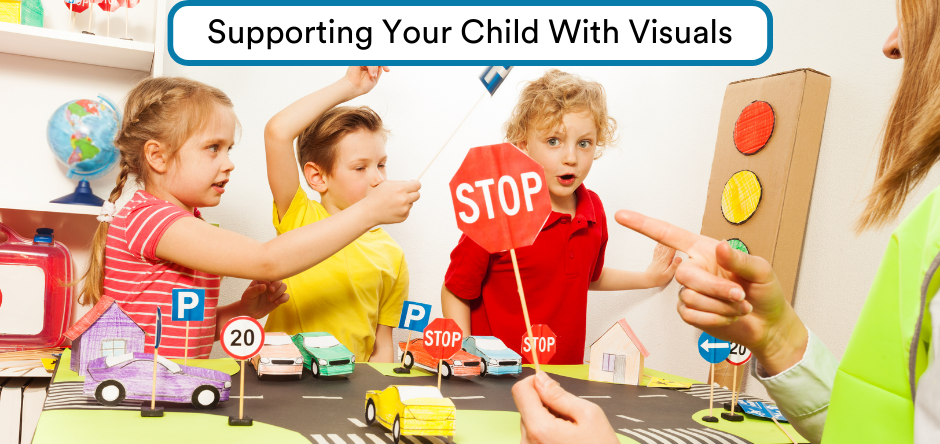
Ensuring your child’s safety is everyone’s number 1 priority. Teaching your child to respond to stop signs can be a great visual prompt as a reminder of locations they can and cannot go around the home.
Place a laminated stop sign on the doors leading outside (or any other areas in the home that are unsafe for your child). This can serve as a reminder to your child to pause and not go out that door if they are unaccompanied by an adult. This will take practice, but once they have the idea down, stop signs can be an excellent prompt!
Visual Schedules
The first-then visual is a simplified visual schedule showing two activities. A full visual schedule can be created to help your child understand several upcoming events. There are many ways to set this up. For example, you could set this up as a schedule of their full day. Or you may create one to support them through a portion of their day, such as the bedtime routine consisting of brush teeth, put on pajamas, bedtime story, etc.
Again, there are many ways you can go about creating this including using pictures or words. You could go about creating one yourself or purchasing one.
Visual Timers
Visual timers can be a really helpful way to help a child who doesn’t quite understand the concept of time, comprehend how much time is left of an activity. The red on the clock visually displays how much time is remaining for an activity or until an upcoming transition.
Visuals can be so valuable in prompting us through our daily lives. Finding effective visual supports for your child can make a huge difference.
About the Author
Ashleigh Evans, MS, is a Board Certified Behavior Analyst. She has been practicing in the behavior analysis field for over 13 years and opened her own independent practice in early 2022. Her experience has been vast across different age groups, diagnoses, and needs. She is passionate about improving the field through education, reformative action, and better supervisory practices, leading her to create content and resources for families and ABA professionals which can be found on her website, https://www.abaresourcecenter.com/.
The post Supporting Your Child With Visuals appeared first on Different Roads to Learning Blog.


