

Description
I’ve been asked to discuss some of the questions I see swirling round the discovery of the reliquary in Jamestown. I wrote about the remarkable find last week on this same blog.
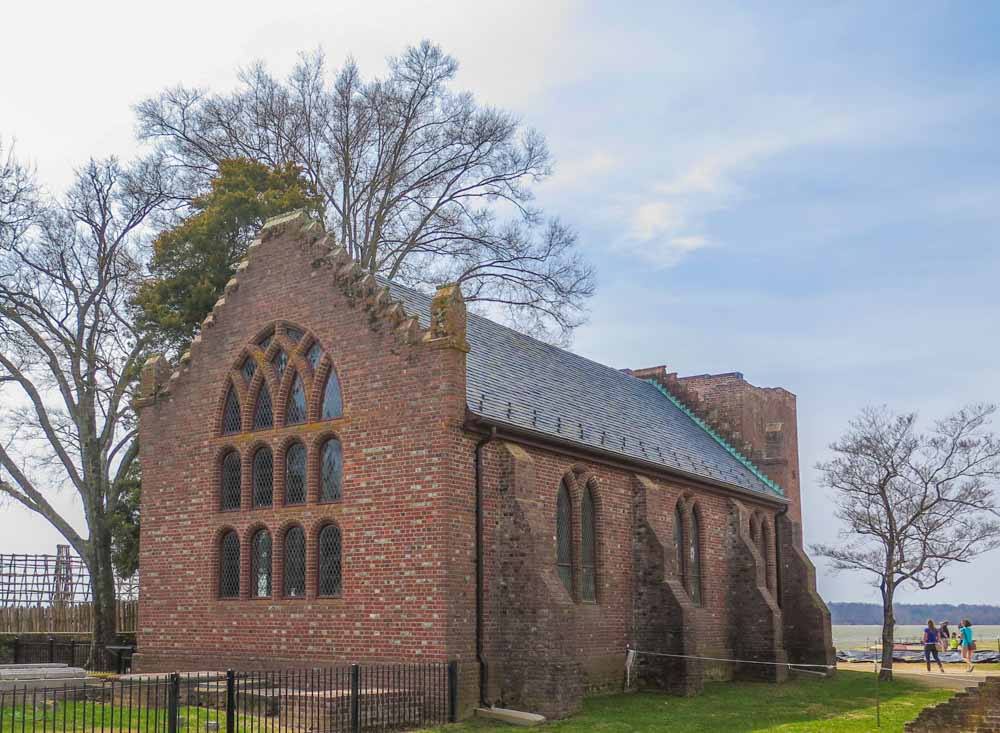 |
| The later Anglican church at Jamestown (as reconstructed at the turn of the 20th century) |
It’s always hard to put ourselves in someone else’s shoes. It’s particularly tough when four hundred years and vast cultural differences separate us. Assumptions about how we think today, in a society informed by modern morality and a foundation of present-day science may be very far afield when set in the context of 1600 England or Virginia.
Today, when a new Catholic church is built, the bishop will oversee the installation of the relics in the altar. In most new churches the relics are installed in a niche made for that purpose and the installation is part of a ceremony. Things were very different in the Virginia colony in 1609.
There were no bishops in Virginia, nor were there any recognized Catholic clergy, though it’s possible Archer was a secret priest or deacon. Nothing at all is known of the person who set the reliquary atop his casket. All we can say for certain is that a traditional Catholic ceremony around the installation of relics would not have been possible in Virginia, in that day.
Catholics may have been tolerated in the Virginia settlement, but a Catholic church would not have been allowed. The only place of worship would have been the first Anglican church and its successors. Given that situation, did Catholics think of that as “their church” too?
If so, did one of them seize an opportunity to put the reliquary under the altar for that reason? We don’t know.
Imagine that Archer brought the reliquary and its contents to America intending to place them in a place of Catholic worship. But before he could do that, he died. We don’t know if he died suddenly or after a period of sickness. That means we have no idea if he had any opportunity to express a deathbed wish, and if so, if the reliquary was involved.
The reliquary was buried about 70 years after the Church of England broke with Rome. While they had adopted some elements of the Protestant Reformation, there was still much similarity between Anglican and Roman rites. Even today there is considerable similarity. How might that have affected Catholics who attended services?
Today we would expect a bishop or a priest to keep custody of a church’s relics. The situation was very different in 1609 Virginia. The colonists had come from an England where Catholicism had been outlawed and the many Catholic relics had found their way to safekeeping underground in Catholic homes.
Consequently we could expect relics to be in the custody of leading Catholics in English communities, recognizing that “leading Catholics” had a different meaning in that day because almost all Catholics were underground due to persecution.
If Archer’s parents were such people, it would not be any surprise that they may have entrusted him with relics with which to establish a Catholic outpost in Virginia. The fact that there was no bishop in Virginia may not have mattered, from the spiritual perspective of the settlers. Life itself was enough of a struggle that they were forced to be practical and do the best they could.
While there is no evidence (as yet) that Archer was a secret priest we do know he was an educated man and he studied the law. Today we would not be surprised to find a person of that description as a Catholic deacon, and that was likely true in 1600 as well. Deacons and Vestrymen tended to be community leaders, and education is often a part of that. So, while we may never know if he was a priest, he may well have been a deacon and for purposes of Catholicism in Virginia, that may have served the same purpose.
Finally, I have a question about the meaning of the reliquary in that time and place. I see its presence as a sign that Catholics were more tolerated at the colony’s founding than many scholars thought. Yet the fact that it remained buried and lost for 400 years speaks to the fact that mortality and turnover was so high that knowledge of the original church – let alone the reliquary beneath it – could not be maintained. Was Catholic tolerance – if real - indicative of broader toleration? And who was tolerant, and who tolerated?
I will be interested in thoughts from the Anglican and Catholic community on this and welcome any discussion.

Source: Raising Cubby
Related Feed Entries
Starting April 1, disabled people across England will be able to travel by bus for free at any time of day. Previously, free bus passes were restricted to off-peak hours on weekdays (between 09:30 and 23:00), making it difficult for pass holders to commute to standard morning jobs or attend late-nig…
6 days ago · From Assistive Technology Blog
Fallbrook artist Joel Anderson, “The Artist of Smiles,” has his dog portraits on display at TERI Campus of Life in San Marcos through October 2026.
By Debra Muzikar
Last week I had the pleasure to assist Fallbrook artist Joel Anderson in hanging his dog series art outside Teri’s Co…
13 days ago · From The Art of Autism
This list is meant as a springboard for discussion and more awareness into the female experience with autism.
By Samantha Craft
Females with Autism: An Unofficial List
Section A: Deep Thinkers
A deep thinker
A prolific writer drawn to poetry
*Highly intelligent
Sees things at multiple levels, incl…
24.08.2026 · From The Art of Autism
The Biology of Breaking
By Jessica Penot
An autistic meltdown is an involuntary loss of behavioral, emotional, and physiological regulation that occurs when an autistic person’s ability to cope with sensory, cognitive, emotional, or environmental demands is exceeded. Unlike a temper tantrum, a meltd…
19.08.2026 · From The Art of Autism
Living in Full Color
By Mimi Oh
Let’s be brutally honest: Being a Black woman is already hard enough. As part of the overlap of intersectionality, I fully identified as a dark-skinned, cisgender, bi/demisexual,
Catholic, Black-American woman of Nigerian descent, whose culture revolves around the Igb…
18.08.2026 · From The Art of Autism
Rate
Info

Recommend

