

May is Mental Health Month. The Art of Autism throughout May would like to focus on stories about those with dual diagnoses.
By Jeanette Purkis
I have a diagnosis of an Autism Spectrum Condition and atypical schizophrenia. In my 42 years I have accessed a large number of publicly and privately funded mental health services. My mental illness is difficult enough to manage by itself but I often experience more difficulties trying to get help form mental health services than those caused by the illness.
Even now, Autism – and particularly female Autism – is not well understood among many mental health clinicians. This often results in misdiagnosis, misunderstandings and mistreatment. I have had psychiatrists tell me I am lying when describing my symptoms because my experience apparently didn’t match what they had in their diagnostic manual. I had one doctor in the 1990s whose rather arrogant attitude coupled with apparently no understanding of Autism among adult women was instrumental in my spending the next three years in institutions of varying degrees of malevolence.
Some types of stigma have happened over and over again:
- While a patient in hospital being told that violence committed against me by other patients was my fault because I was being ‘annoying’.
- A level of ignorance around Autistic communication styles resulting in difficulties accessing services. An example is having my need for care questioned because the only question asked by crisis services around my capacity was ‘are you going to work?’ Because I am literal I didn’t realise that I needed to expand upon this question and explain that yes, I was still going to work but that I was not coping in any other domain of life, including personal hygiene, grooming or eating and that I was too frightened to use any household appliances in my apartment due to delusional thinking about ghosts in my house. This inability to have my needs understood and the ongoing denial of assistance meant that I experienced terrifying hallucinations and intrusive thoughts for months with no assistance and increasingly believed that I would never get help. This risk of self-destructive behaviour increased with each day that I didn’t get help.
- Clinicians making flippant comments about my Autism not realising the impact an apparent challenge to my established diagnosis had on my anxiety levels and sense of identity. And example was ‘You’re too cool to be Autistic. Look at those Converse sneakers!’
- Being given advice in clinical settings which was highly unhelpful, such as ‘why don’t you quit your (very well-paid and fulfilling) job and go onto the ($12,000 per annum) disability pension?’
- Having seclusion used as a punishment. During one hospital stay in the mid-1990s I spent a week in the seclusion room with the door locked and inadequate clothing for the season. I was terrified the whole time.
- Being given a helpful treatment plan based on my needs and then it not being used or mentioned again.
- Having low expectations, assumptions of incompetence and deficits-thinking from mental health clinicians. This is unfortunately consistent across almost every mental health service, hospital or psychiatrist I have used. I always feel like I need to explain that I have written three books, work full-time, own my own home, have given talks at a huge number of conferences and events and conferences, including for TEDx Canberra and so forth.
These sorts of experiences happen to others on the Autism spectrum who also experience mental illness. There is a wide gap in knowledge around Autism and how it interacts with mental illness. It amazes my that so many people tell me that they were misdiagnosed and their experience was questioned by psychiatrists. It is almost like if the person’s experience doesn’t fit the text book, question the person’s lived experience and not the textbook. Not only is this illogical, it is also very damaging.
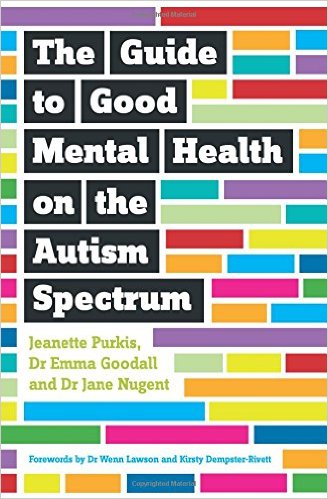
I actually got so sick of these sorts of stigmatizing experiences that I co-wrote a book called The Guide to Good Mental Health on the Autism Spectrum to help Autistic people better navigate mental health services but also to assist mental health clinicians to understand how to respectfully treat Autistic people so that their treatment was actually helpful and not counterproductive.
It is very disappointing that services which exist to help people can be so detrimental to health and recovery. I should note that I have received a lot of very positive and supportive mental health care too.
***
Jeanette Purkis is an author, public servant and passionate advocate for Autistic people and their families. She is the author of ‘Finding a Different Kind of Normal: Misadventures with Asperger Syndrome’ – an autobiography, and ‘The Wonderful World of Work: A Workbook for Asperteens‘- an activity book about employment for teens on the Autism spectrum. Jeanette has also contributed to other books, journals, blogs and websites. Follow Jeanette on her website.
This article was originally posted here.


