
Disappearing act: A chemical brew renders mouse tissues see-through, revealing underlying nerves in dazzling detail.

Description
A combination of chemical cocktails has created mice that are — yes — virtually invisible. And new imaging technology reveals the mice’s underlying nerves and lymphatic system in unprecedented detail.
The reaction when researchers debuted the images today at the 2018 Society for Neuroscience annual meeting in San Diego, California, was nothing short of shock. Even the researchers themselves seemed in awe of their work.
“This is seriously crazy,” lead investigator Ali Ertürk of the Ludwig Maximilian University of Munich, Germany, told Spectrum. “You are seeing through bones and muscles — they are invisible now.”
The method is the newest iteration of tissue-clearing technology, in which researchers use chemical baths postmortem to render organs or even whole organisms transparent. Looking through the clear layers of tissue, researchers can observe cells tagged with the glow of fluorescent proteins.
The new technique, dubbed vDISCO, is a step up from its predecessor, uDISCO, which generated the first images of an intact mouse nervous system. The older technique left traces of bone and tissue that muddied the images. The additional chemicals used in vDISCO remove color from tissue and decalcify bones.
Shine bright:
vDISCO overcomes another obstacle: Muscle and other tissues emit a natural glow in certain lights, which can outshine the gleam of fluorescent proteins.
Ertürk’s team boosted the proteins’ signal by attaching bright fluorescent dyes to miniature antibody fragments, or nanobodies, that bind the proteins. They pushed the nanobodies deep into the mouse tissue with a pressurized pump. The technique boosted the fluorescent signal nearly 120-fold.
“We enhanced the signal that is embedded in the body, and we enhanced the transparency,” Ertürk says. “Combined together, it becomes really powerful.”
The signal boost provides a strikingly detailed picture of mouse nerve cells and vasculature. And the signal is permanent: Scientists can revisit their samples years down the road.
Ertürk’s team applied the approach to construct a one-of-a-kind comprehensive map of the mouse’s neuronal connections. The images are so detailed that the researchers can follow the path of a particular projection all the way from the spinal cord to the little toe.
[The technique also allowed them to map the locations and numbers of immune cells in the brain called microglia.]
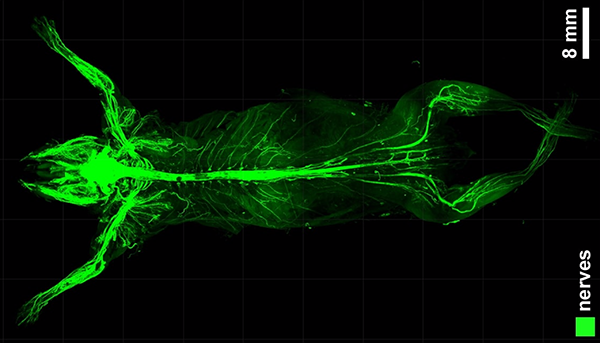
Long links: vDISCO can trace the path of neuronal projections all through the body.
Immune connection:
Because the technology allows researchers to study entire biological systems in whole animals, it may illuminate how these systems can go awry.
The team tested the technique in a mouse model of traumatic brain injury. They found that the effects of the injury extend far into the body, to where nerves and muscles meet in the torso, for example. At these junctions, the nerve endings are smaller and less branched in the injured mice than in controls.
The researchers also used vDISCO to take a closer look at the vasculature surrounding the brain. They observed vessels that traffic immune cells to the brain, confirming reports that the body’s immune-related lymphatic system extends to the brain2.
Some of these lymphatic vessels serve as a passageway between the brain and the skull, the team found. The results hint that the skull plays an active role in the immune system.
“To me, it’s exciting to think that skull is really a living part of the brain,” Ertürk says.
The technology may shed light on atypical immune functioning in many conditions, including Alzheimer’s disease and autism.
For more reports from the 2018 Society for Neuroscience annual meeting, please click here.
The post Invisible man? Move over for invisible mouse appeared first on Spectrum | Autism Research News.
Source: Spectrum News
Related Feed Entries
In a landmark move for the global assistive technology community, the Ministry of Electronics & IT recently unveiled a comprehensive strategy to transform India from a text-heavy digital landscape into a voice-first ecosystem. Launched at the India AI Summit Expo 2026, this initiative is anchore…
8 days ago · From Assistive Technology Blog
By Sam Blanco, PhD, LBA, BCBA
There’s a famous quote from W. Edwards Deming that says “Without data, you’re just another person with an opinion.” While Deming wasn’t a behavior analyst, this statement aligns closely with how BCBAs approach their work.
Most BCBAs will report how much they love …
8 days ago · From Different Roads to Learning
Adidas has announced the launch of the Supernova Rise 3 Adaptive, its first performance running shoe specifically designed for athletes with disabilities. Developed over several years, the shoe was inspired by Chris Nikic—the first person with Down syndrome to complete an Ironman—who previously stru…
10.04.2026 · From Assistive Technology Blog
Dear Friends,
I never write for our blogs but I wanted to share this glimmer of hope.
This weekend, an acquaintance of a friend of a friend asked me to view a French film called “No Filter Café” at a Socially Relevant Film Festival in NYC.
It’s a film in French about 5 young men…
31.03.2026 · From Different Roads to Learning
With the April 24, 2026, deadline for the updated ADA Title II regulations rapidly approaching, the landscape of digital inclusion is shifting from reactive accommodation to proactive accessibility. This mandate requires large public institutions to ensure that every facet of their digital presence—…
28.03.2026 · From Assistive Technology Blog
Rate
Info

Recommend

