

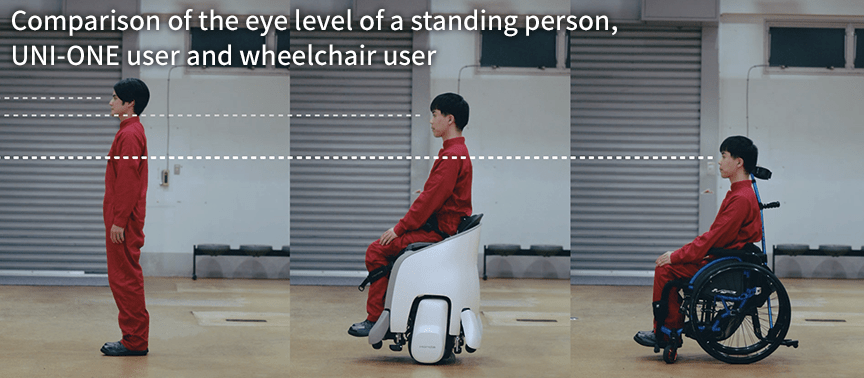
More than 12% of American adults face difficulties walking or climbing stairs due to disabilities, relying on mobility aids like wheelchairs, which, while helpful, come with limitations. Traditional wheelchairs often restrict social interaction, as users are not at eye level with others and must use their hands to maneuver, preventing multitasking. Honda Robotics has introduced the UNI-ONE, a hands-free wheelchair that operates similarly to a Segway. The device lifts users to a semi-seated position at eye level with others, allowing hands-free control through body weight shifting or a joystick. The battery-powered UNI-ONE reportedly offers a range of about 5 miles or two hours of use, with a top speed just below 4 miles per hour. Honda aims to launch the UNI-ONE in 2025, leasing it for around $800 a month in Japan, with plans for the US market as well.
While a similar hands-free wheelchair, Omeo, is available for purchase at around $30,000 in the US, the UNI-ONE’s leasing model may make it more accessible to various establishments such as amusement parks and college campuses. By offering these hands-free wheelchairs to visitors, these locations can ensure an inclusive environment, enabling everyone to fully enjoy their facilities without mobility limitations.
How Does UNI-ONE Work
The UNI-ONE is a hands-free personal mobility device designed to offer greater independence and joy to various users. It stands out with two main features: height adjustability and hands-free maneuvering capabilities. This device allows users to change positions from a stable, low setting when getting on to a high position for better eye-level alignment with standing individuals while moving. This feature encourages natural communication and makes mobility more engaging. Additionally, users can steer and move in all directions using body weight, leaving their hands free for other tasks, thereby expanding the potential for diverse users.
(Click images below to enlarge)

With a focus on user experience, the UNI-ONE ensures high riding stability and incorporates anti-tipping measures through its advanced control technology. The device automatically adjusts its position to prevent tipping, ensuring safe and stable movement. It also allows hands-free operation, controlled by shifting body weight, making mobility an effortless and enjoyable experience.
Powered by cutting-edge technology, such as the Human-Machine Cooperative Balance Control Technology and the original Honda Omni Traction Drive System, the UNI-ONE interprets natural posture movements to estimate user intentions and control wheel movements for stability. This tech enables easy direction changes and smooth, responsive movement in any direction, enhancing the overall user experience.
The device’s mechatronics technology ensures smooth transitions between high and low positions while minimizing impact and ensuring a comfortable shift. For instance, the incorporation of a soft rubber bushing between components facilitates smoother mode changes while reducing jarring impacts during transitions.
The UNI-ONE aims to revolutionize mobility for various situations. For instance, it can alleviate the burden on elderly family members in theme parks, help individuals with lower limb impairments perform tasks while moving, and allow wheelchair users to interact at eye level with others. The goal is to enhance people’s joy and independence in their daily lives by providing new mobility options.
Looking ahead, the UNI-ONE envisions entertainment applications, like XR games, leveraging its hands-free capabilities to integrate digital features into real-world experiences. The ultimate goal behind UNI-ONE’s development is to bring smiles to people’s faces, promoting fun, independence, and enjoyment in their lives, regardless of disability or age. Continuous testing, collaboration with users, and data accumulation aim to refine and further improve the device, making it more accessible and user-friendly for all.
This blog was written mostly using chatGPT, a potential tool for increased accessibility. Do you think this is an appropriate use of chatGPT? Why or why not? Let me know!
The post Introducing UNI-ONE: A Revolutionary Hands-Free Mobility Device Redefining Independence and Joy for Diverse Users appeared first on Assistive Technology Blog.


