

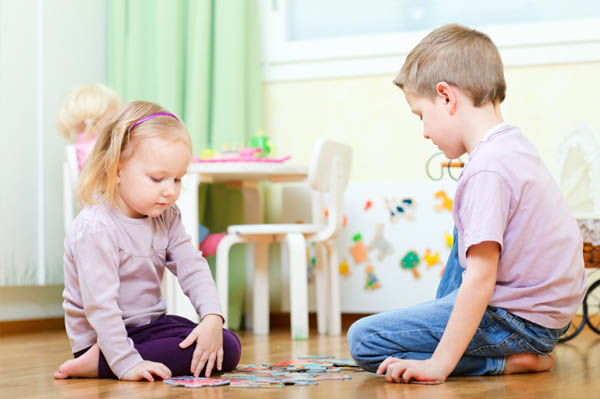
 When I first came across this study, “Behavioral Training for Siblings of Autistic Children,” I was immediately hesitant. There’s something about the idea of sibling-as-therapist that makes me cringe a little bit. When I work with the families of children with autism, the hope is that the siblings of the child with autism still have a childhood without being pushed into the role of caregiver. And I also want the child with autism to have independence and feel like an individual who is heard, which may be more challenging if their siblings are issuing demands just as a parent or teacher would. But as I read the study, I realized that the work they completed had incredible social significance.
In the study, there were three pairs of siblings. The ages of the children with autism ranged from 5 years old to 8 years old. The ages of the siblings ranged from 8 years old to 13 years old. The researchers trained each sibling of a child with autism how to teach basic skills, such as discriminating between different coins, identifying common objects, and spelling short words. As part of this training, the researchers showed videos of one-on-one sessions in which these skills were taught, utilizing techniques such as reinforcement, shaping, and chaining. What the researchers did next was the part that really stood out to me: they discussed with the siblings how to use these techniques in other environments. Finally, the researchers observed the sibling working with their brother/sister with autism and provided coaching on the techniques.
It should be noted here that the goal of the study was not to have the siblings become the teacher of basic skills. Instead, it was to provide a foundation of skills in behavioral techniques for the sibling to use in other settings with the hope of overall improvement in the behaviors of the child with autism. The researchers demonstrated that, after training, the siblings were able to effectively use prompts, reinforcement, and discrete trials to effectively teach new skills. But, perhaps the most meaningful aspects of the study were the changes reported by both siblings and parents. The researchers provide a table showing comments about the sibling with autism before and after the training. One of the most striking comments after the training was, “He gets along better if I know how to ask him” (p. 136). Parents reported that they were pleased with the results and found the training beneficial.
This study provides excellent evidence that structured training for siblings has real potential for making life a little easier for the whole family. The idea isn’t that they become the therapist, but instead that knowledge truly is power.
References
Schriebman, L., O’Neill, R.E. & Koegel, R.L. (1983). Behavioral training for siblings of autistic children. Journal of Applied Behavior Analysis. 16(2), 129-138.
WRITTEN BY SAM BLANCO, MSED, BCBA
Sam is an ABA provider for students ages 3-12 in NYC. Working in education for ten years with students with Autism Spectrum Disorders and other developmental delays, Sam has developed strategies for achieving a multitude of academic, behavior, and social goals. Sam is currently pursuing her PhD in Applied Behavior Analysis at Endicott College.


