

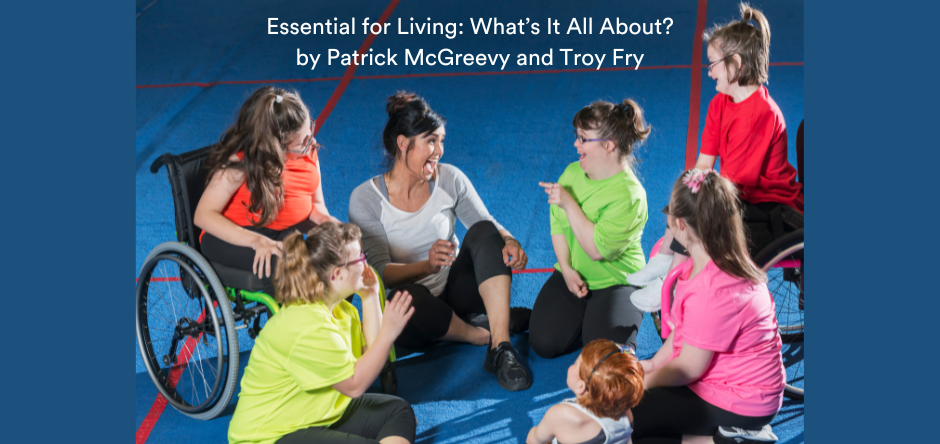
By Patrick McGreevy and Troy Fry, Essential for Living
Essential for Living was published in 2013 and is a result of the guidance of our professors, Ogden Lindsley, Don Baer, and Mont Wolf, and the many children and adults with moderate-to-severe disabilities and limited skill repertoires. While many of these children and adults have autism, many others have congenital disorders like Down syndrome, Angelman syndrome, and any one of a number of other congenital conditions or pervasive disabilities that were acquired later in life.
Essential for Living is about all of these children and adults. It focuses on teaching the Essential Eight life skills, which help learners achieve better quality of life and eventually transition beyond a school setting:
- Making Requests (mands)
- Waiting after the request is made
- Accepting Removals: Transitions, Sharing, and Taking Turns
- Completing Required Tasks
- Accepting “No”
- Following Directions related to Health and Safety
- Completing Daily Living Skills related to Health and Safety
- Tolerating Situations related to Health and Safety
Our mission is to bring these Essential Eightlife skills to these children and adults, most of whom have difficulty fully understanding abstract concepts and making consistent progress on either a developmental curriculum like the VB-MAPP, or academic standards like the Common Core or Alternate Assessment Standards. The goal of this mission is to improve quality of life, rather than to catch up to typically developing peers or reach academic standards designed for those peers.
By shifting the learning goals away from meeting a more academic curriculum, Essential for Living offers more individualized and inclusive therapy that bolsters success among a wider range of learners, including individuals with more limiting or severe disabilities who are not a good fit for assessments like the VB-MAPP or the ABLLS-R.
To accomplish this goal, the EFL Handbook and EFL: The Teaching Manual include:
1. Issues you should consider addressing and skills you should consider teaching first;
2. Teaching procedures, some of which may not be familiar to you, that may be required with children and adults with limited skill repertoires; and
3. Performance criteria that include fluency.
An assessment with EFL will result in a list of specific skill deficits and problem behaviors that can become goals and objectives in an IEP or ISP, rather than a numerical indication of performance levels with respect to other learners or published performance standards. Learners will also receive alternative methods of speaking for non-verbal children and adults that last a lifetime.
Teaching with EFL will result in more effective teaching procedures and behavior plans, and more meaningful outcomes; more efficient IEP reviews and quarterly progress reports which include small increments of learner progress; and meaningful and achievable performance standards for teacher/therapist self-evaluation. Later, when it’s time for a transition plan, Essential for Living will guide instruction toward skills and outcomes that will matter in a post-school or post-clinic environment.
By making essential life skills obtainable early in life and beyond the classroom, we meet learners where they are. When we start with these strong foundations, we ensure better quality of life for all learners, no matter what their ability level.
About the Authors
Patrick McGreevy, Ph.D., BCBA-D
Patrick McGreevy received B.S. and M.A. degrees in Psychology and Special Education, respectively, from the University of Iowa. He was a special education teacher for eight years, working with children and young adults with moderate-to-severe developmental disabilities. He received the Ph.D. degree in Education from Kansas University under the guidance of Ogden R. Lindsley. He has served on the faculties of the University of Missouri-Kansas City, Louisiana State University, the University of Central Florida, and the Florida Institute of Technology. He is the author of Teaching and Learning in Plain English, an introduction to Precision Teaching, and the founder and first editor of the Journal of Precision Teaching and Standard Celeration Charting. He is the author of ten journal articles and a book chapter on teaching verbal behavior. He is the first author of Essential for Living, a functional skills curriculum, assessment, and professional practitioner’s handbook based on B. F. Skinner’s analysis of verbal behavior for children and adults with moderate-to-severe disabilities. For the past 30 years, he has provided consultations for children and adults with developmental disabilities in school districts, residential programs, and hospitals, specializing in the simultaneous management of aggressive and self-injurious behavior and the teaching of communication and language skills to individuals with limited repertoires. He is board certified behavior analyst, has given hundreds of presentations and workshops around the world, and is the recipient of the Ogden R. Lindsley Lifetime Achievement Award of the Standard Celeration Society. He is the President and Director of Consultation and Training Services for Essential for Living, P.A.
Troy Fry, M.S., BCBA
Troy Fry received his B.A. in Science and Mathematics from North Dakota State University and M.S. degree in Behavior Analysis and Therapy from Southern Illinois University. Troy attended the University Of Kansas doctorate program in the Department of Human Development and Family life for four years. He has been a Board Certified Behavior Analyst for the past 25 years. Troy has worked with children and adults with significant developmental disabilities in schools, clinics, hospitals, and residential programs across North America and Europe. Over the years, he has held the positions of teacher, consultant, clinical director, and chief executive officer. He is the second author of Essential for Living, a functional skills curriculum, assessment, and professional practitioner’s handbook based on B. F. Skinner’s analysis of verbal behavior for children and adults with moderate-to-severe disabilities. He is the Associate Director of Training and Consultation Services for Essential for Living, P.A.
The post Essential for Living (EFL): What’s It All About? appeared first on Different Roads to Learning Blog.


