

School learning communities are dynamic and complex, and meeting the challenge requires a detailed understanding of how such communities work, a task that is ideally suited to Ecological Assessment. Ecological Assessment for successful school inclusion settings can be a vital part of the structure of maintaining scientifically-grounded, evidence-based practices in schools. Like functional assessment, Ecological Assessment uses the tools of Applied Behavior Analysis – behavioral definitions, direct observation and data collection, task analysis, simple statistical analysis, structured interviews – and applies them to the ecosystem of the classroom and other settings in schools.

In 2007, Cooper, Heron, & Heward wrote: “An ecological approach to assessment recognizes the complex interrelationships between environment and behavior. In an ecological assessment a great deal of information is gathered about the person and the various environments in which that person lives and works. Among the many factors that can affect a person’s behavior are physiological conditions, physical aspects of the environment (e.g., lighting, seating arrangements, noise level), interactions with others, home environment, and past reinforcement history. Each of these factors represents a potential area for assessment.” (p. 55)
Ecological Assessment has been discussed in behavior analysis for at least the past 45 years. Wallace and Larson (1978) described Ecological Assessment as referring to the analysis of an individual’s learning environment and his/her interactions within and across these settings. In stressing the importance of ecological assessment, Hardin (1978) said that “appropriate and effective intervention cannot occur without an adequate understanding of the child and his or her environment.” Heron and Heward (1988) pointed out that sometimes students’ situations warrant comprehensive study, saying, “…some students’ learning/behavior difficulties are subtle and complex and, thus, necessitate a more global assessment to ensure the most appropriate instructional approach.” They suggested that Ecological Assessment should be based on various sources of information such as student records, interviews, formal and informal tests, and direct observation, and include an examination of specific influences within a setting such as:
- Spatial Density
- Seating Arrangement
- Noise
- Student-Student Interaction
- Classroom Lighting
- Teacher-Student Interaction
- Home Environment
- Reinforcement History
According to Carroll (1974) a model of Ecological Assessment consists of six steps:
- “Delineation of the assessment goals (i.e., identify the data to be collected and how they will be used)
- Formation of a conceptual framework within which to assess the learner and the environment (i.e., identify the relative importance of learner and environmental factors)
- Implementation of the assessment plan (i.e., conduct direct observations, inspect work samples or products)
- Evaluation of assessment results
- Development of a set of hypotheses (i.e., relationships between student behavior and identified learner characteristics and environmental factors)
- Development of a learning plan (i.e., an intervention strategy designed to match learner characteristics with appropriate environmental settings).”
Like functional assessment, Ecological Assessment is part of an analysis involving students and the environment. While functional assessment identifies specific behaviors (usually problem behaviors) exhibited by a student as the target of the assessment, Ecological Assessments have both a setting focus and a student focus. Ecological Assessments study the nature of all behaviors required to be reinforced in a particular setting and the specific circumstances under which those behaviors must occur. It then compares these requirements to the abilities and experiences of the student. The central question in an Ecological Assessment is, “What does the student need to do to succeed?”
Why Conduct an Ecological Assessment?
There are many reasons to conduct an Ecological Assessment:
- With students making transitions between programs, Ecological Assessments can supplement the typical discussions between sending and receiving teams, providing formal observations, data-taking, setting inventories, and structured interviews that allow for a smoother transition
- For students who are less-than-engaged in class and exhibit off-task behavior, Ecological Assessments help teachers identify and eliminate the barriers to on-task behavior and, as efforts are made to resolve issues, provide both a baseline and a convenient on-going monitoring vehicle for both the student’s behavior and any continued existence of the barriers
- When evaluating student readiness, Ecological Assessments identify the key skills actually reinforced in target environments, so that specific, concrete, realistic preparations can be implemented
The Future of Ecological Assessment
Educational teams in schools tackle problems encountered in inclusion settings every day, both from the assessment side and the student preparation side. While Ecological Assessment has been frequently discussed as a valuable tool and would seem to be ideal for gaining a detailed understanding of environmental barriers and challenges in classrooms and other inclusion settings, there is little established structure to guide clinical implementation.
At this point, one Ecological Assessment is very likely to look completely different from another. Like functional assessment, Ecological Assessment in the future must take on recognized and validated structure that is data-based, reliable, and highly descriptive of setting characteristics and related student abilities. Insights into how to provide meaningful student inclusion experiences depend on well-developed tools that synthesize and easily communicate information about complex challenges.
Well-structured Ecological Assessments will provide a vital means of approaching inclusion that, in addition to providing a detailed analysis, will create a structure that can extend well beyond the initial decision-making phase of programming, and, without a doubt, promises to contribute enormously to student program development.
For more on Ecological Assessment, check out our newest product by Fovel, the SEAT!
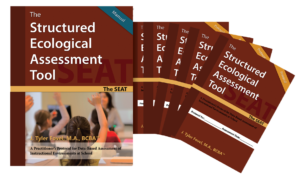
This innovative new protocol and manual provides essential structure to facilitate ecological assessment of inclusion settings that is systematic with ABA principles and straightforward to implement. This assessment tool is a must for practitioners and educational teams at all levels and grades, who need to design, and evaluate student inclusion experiences using evidence-based methodologies.
This week only, get the SEAT for 15% off with promo code SEATNEW.
WRITTEN BY J. TYLER FOVEL, M.A., BCBA
Tyler Fovel has worked in the field of Applied Behavior Analysis for over 40 years, with all ages of students and with dozens of educational teams. He has published manuals on educating students with autism and related developmental disabilities: The ABA Program Companion and The New ABA Program Companion (DRL Books). He lives in Massachusetts with his wife, Jan, and their golden retriever, Lucy.
The post Ecological Assessment For Successful School Inclusion Settings appeared first on Different Roads to Learning Blog.


