

Description
In a recent PLOS ONE journal article, researchers Jessica McCain, Brittany Gentile, W. Keith Campbell posit that perhaps geek culture is a way of sustaining a narcissistic self-view.
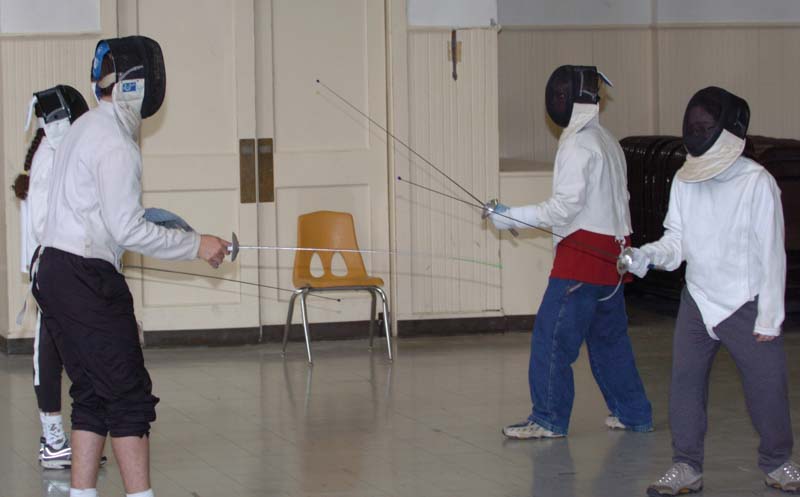 |
| Geeks with Swords (c) JE Robison |
While I agree that it might look that way on the surface, I think their conclusion is wrong; founded upon an incorrect or incomplete understanding of geeks and geek culture. With all due respect, I suggest that perhaps the authors made an all-too-common mistake. They interpreted observations of self-focused behavior as narcissism, when they were actually seeing autistic traits; either autism or the much more common "broader autism phenotype." As a result, the article as it stands is harmful to autistic culture, and geek culture, because it perpetuates a wrong stereotype.
The article focuses on the geek community’s outsized interest in online gaming, massive multiplayer games, role playing games, and science fiction, or comics or fantasy. Games and conferences have grown so large that they’ve become major cultural events. And people naturally draw conclusions about those who attend, and how they may be different from others in the community.
It’s well known that we geeks get lost in our own worlds, and in fantasy worlds of various sorts. The question here is, why does that happen? If a person is fully aware of the wider world, but chooses to ignore outside signals and focuses on himself that is narcissistic. If we do that because we are oblivious to much of what goes on around us, and we are blind to the signals of others, that is an autistic spectrum trait.
Most autistic children experience bullying and mistreatment, growing up. That is an unfortunately consequence of acting differently, and being insensitive to other kids. As they get older, autistic kids often withdraw from social contact, even as they desire it. They may gravitate to online communities, where they are less likely to appear different or disabled, and in fact may seem exceptional due to their intense focus.
To a large extent, that explains the path autistics follow into gaming and fantasy. It’s founded on isolation and social disability, and narcissism has no part of that picture. Yet narcissism is often assumed by observers, incorrectly. That is a natural reaction for a person who is not autistic. They see various signals from other people, and it never occurs to them that an autistic person next to them might be oblivious to the same signals. So when the autistic person fails to respond as they do, they assume his lack of response is deliberate and informed, when in fact it’s not.
In comparison, narcissism is saying “I see you, but I love myself more than you or anyone else.” That is seldom the situation for autistic people, who tend to suffer from the opposite – chronic self-loathing and poor self-esteem. When it comes to self-focus, autistic people do so because they are not fully aware of the people around them, because they have a communication disability. That is the essence of autism.
After reading this essay in original form, BU Psychology Professor Catherine Caldwell-Harris pointed out that geeks (or nerds as others say) are also drawn into online worlds and gaming in part because they have strong systemizing tendencies, which are traits of the broader autism phenotype. Cambridge researcher Simon Baron Cohen has written a lot about systematizers and that kind of thinking.
After reading this essay in original form, BU Psychology Professor Catherine Caldwell-Harris pointed out that geeks (or nerds as others say) are also drawn into online worlds and gaming in part because they have strong systemizing tendencies, which are traits of the broader autism phenotype. Cambridge researcher Simon Baron Cohen has written a lot about systematizers and that kind of thinking.
My experience as an autistic adult informs my interpretation of geek cultural observations. As an autistic person I know all too well what it’s like to miss the signals others around me see, and suffer as a result. Am I suggesting every geek is autistic? Of course not. What I am suggesting is that a great many geeks have some autistic traits and a considerable number are on the spectrum. And I’m sure a few are narcissistic too, but I believe autism is the best explainer of the behaviors described in the paper.
We should be very careful about applying labels like narcissist to large swaths of the population. It’s particularly noteworthy that the approaches one would take to deal with narcissism are fundamentally different from what one would use to address autism. Treating autistics as narcissists will not only be counterproductive, it will be harmful.
John Elder Robison
John Elder Robison is an autistic adult and advocate for people with neurological differences. He's the author of Look Me in the Eye, Be Different, Raising Cubby, and the forthcoming Switched On. He's served on the Interagency Autism Coordinating Committee of the US Dept of Health and Human Services and many other autism-related boards. He's co-founder of the TCS Auto Program (A school for teens with developmental challenges) and he’s the Neurodiversity Scholar in Residence at the College of William & Mary in Williamsburg, Virginia.
The opinions expressed here are his own. There is no warranty expressed or implied. While reading this essay may give you food for thought, actually printing and eating it may make you sick.

Source: Raising Cubby
Related Feed Entries
Part 1: Why Great Clinicians Can Struggle as Supervisors
by: Cheryl Davis, PhD, BCBA-D, Dana Reinecke, PhD, BCBA-D
Clinical expertise does not automatically translate into supervisory expertise. Supervisors need explicit instruction, modeling, practice, feedback, and ongoing support, just like…
11 days ago · From Different Roads to Learning
Starting April 1, disabled people across England will be able to travel by bus for free at any time of day. Previously, free bus passes were restricted to off-peak hours on weekdays (between 09:30 and 23:00), making it difficult for pass holders to commute to standard morning jobs or attend late-nig…
01.09.2026 · From Assistive Technology Blog
Fallbrook artist Joel Anderson, “The Artist of Smiles,” has his dog portraits on display at TERI Campus of Life in San Marcos through October 2026.
By Debra Muzikar
Last week I had the pleasure to assist Fallbrook artist Joel Anderson in hanging his dog series art outside Teri’s Co…
25.08.2026 · From The Art of Autism
This list is meant as a springboard for discussion and more awareness into the female experience with autism.
By Samantha Craft
Females with Autism: An Unofficial List
Section A: Deep Thinkers
A deep thinker
A prolific writer drawn to poetry
*Highly intelligent
Sees things at multiple levels, incl…
24.08.2026 · From The Art of Autism
The Biology of Breaking
By Jessica Penot
An autistic meltdown is an involuntary loss of behavioral, emotional, and physiological regulation that occurs when an autistic person’s ability to cope with sensory, cognitive, emotional, or environmental demands is exceeded. Unlike a temper tantrum, a meltd…
19.08.2026 · From The Art of Autism
Rate
Info

Recommend

