

Description
Off and on, you may have heard or read about Internet of Things (IoT). In the coming years, it is supposed to be a new phenomenon (it actually already is) that will make everything much easier and convenient for everyone. But what does it mean? What exactly is it, and how would it help people with disabilities?
Let's start with the basics - What is Internet of Things? In the simplest of terms, it means that you, as a person, control everything around you (yes, everything!) through the internet. What that also means is that you don't have to physically access an object to make it do something.
Let's simplify this a little more further.
Let's say you have a set of lights in your bedroom - one is a bulb in the ceiling and the other is a bedside lamp. When you go to bed, you physically reach the switch on the wall to turn off the ceiling light, and do something similar with the lamp as well (push a button on it to turn it off). In the morning, when you wake up, you push the button on the lamp again to turn it on, then stumble into the bathroom and look for the light switch, turn it on, and do your business. Everything after that (morning coffee, for example) requires a manual interaction with specific devices also.
With Internet of Things, everything is automated. Before going to bed, you either tell a "smart" device - "turn off all lights", use an app on your phone, or make a gesture towards a smart device that it understands as a "turn off all lights" signal. When you wake up in the morning, you can have your bedroom lamp and bathroom lights turn on automatically at the same time. Half an hour later, coffee would be ready.
The basic idea here is that everything around you is connected to the Internet - from your lights in the house to your garage door to your car. With voice commands, mobile apps or gestures, you can set up a sequence in which everything you need readies itself without you having to manually interact with them.
Sticking with our example above - after you drink your morning coffee, you ask a device what the weather is like, what the news headlines are for today, and when the next bus is arriving at your nearest bus station. That device will answer all of your questions without you having to open up your other devices (computer, tablet, phone) to find those information.
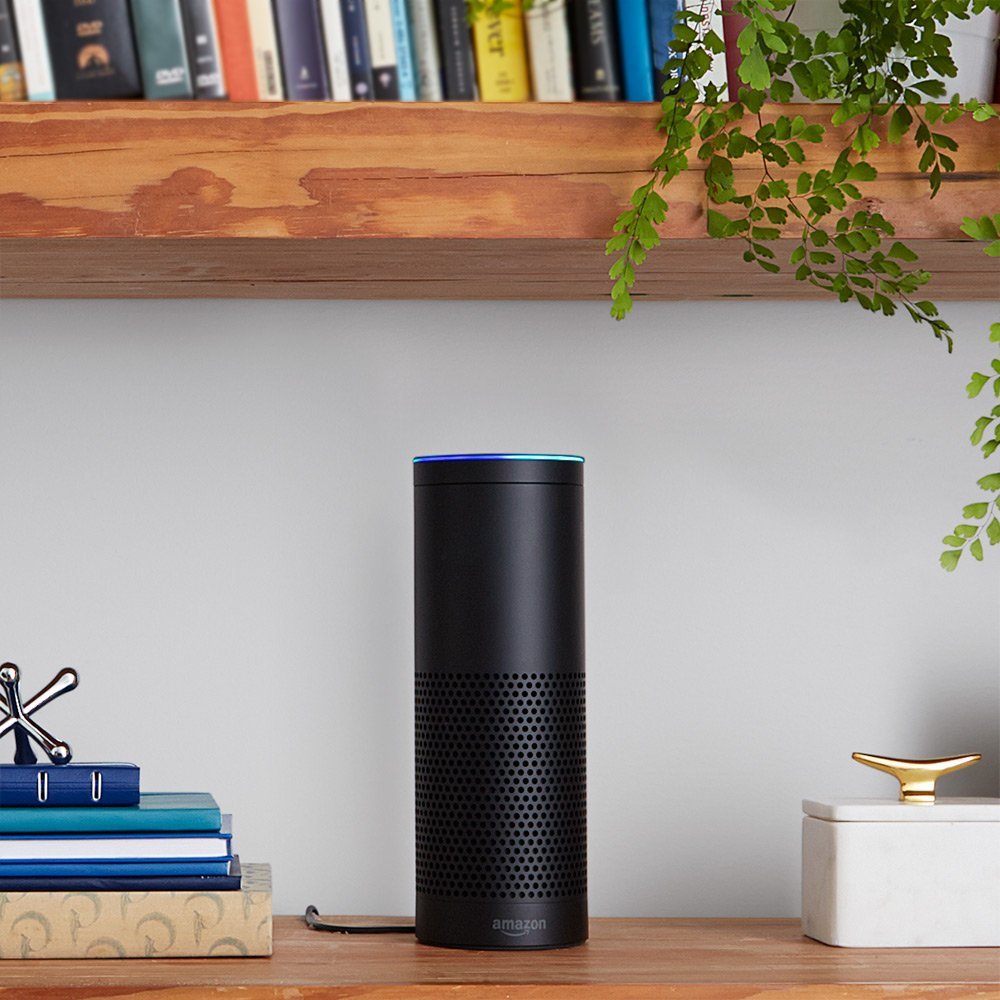
There are several companies that have made lots of amazing innovations in the IoT world. One of those innovations is Amazon's Echo - a little, innocuous looking device that just sits in a corner, but does so many unbelievably powerful things. As a user you can just speak to It and ask it to perform certain actions, and it will do it for you in a jiffy.
What kind of things can it do though?
- To begin with, it can tell you the weather and traffic conditions. ("Alexa*, what's the weather like?", "Alexa what's the traffic like?")
- Read Kindle and Audible books to you, and play music for you. ("Alexa, play the Kindle book 'Be Here Now'", "Alexa, play 'The Beatles')
- Look up events and appointments on your calendar and let you know what your day looks like. ("Alexa, what does my day look like?")
- Help you go to the movies by finding the nearest theater and local timings. ("Alexa, where is Deadpool playing?")
- Find local businesses and restaurants. ("Alexa, what time does the nearby pharmacy close?")
- Add items to your shopping list and also re-order previously ordered items from Amazon with just one voice command. ("Alexa, reorder laundry detergent", "Alexa add coffee filters to my cart")
- Helps you keep track of important tasks. ("Alexa, put 'file taxes' to my to-do list")
- Control all lights and other devices around your house. ("Alexa, turn on light 1", "Alexa, turn off the TV")
- Control your thermostat. ("Alexa, set my bedroom temperature to 68")
- Play games, order an Uber ride, order a pizza from Dominos!
- Lots and lots of other things!
*Amazon Echo is always listening for the keyword "Alexa". If you start a sentence with Alexa, it knows that it is directed towards it (her?).
This video should give you a good understanding of how a person with disabilities can use Echo/Alexa at home.
Automation, in general, is a big victory for the regular consumer in terms of convenience. However, it brings a much bigger convenience and independence factor to people with disabilities, especially anyone who is blind, in a wheelchair, paraplegic, bed ridden because of a spinal cord injury, or doesn't have good motor skills. It saves them a lot of time and energy by not making them interact with other devices that they may not have skills for or are unable to use them because of various disabilities. The only device they interact with is Echo, through voice, and it provides them with the results and information they are looking for instantly, and thus, saves them a lot of trouble. A person in a wheelchair doesn't have to try to reach a light switch that's in an awkward corner of a room, a person with not good motor skills doesn't have to flip through pages or operate an e-reader to read their books, and a blind person doesn't need to navigate a website on an electronic device to order a pizza anymore.
Automation through Internet of Things doesn't only have to be at home. A device like Alexa can be installed by an employer at work as well so that employees with disabilities can be more comfortable in their work environments. A device like Echo is very inexpensive ($179), and it just makes the ability to provide accommodations an inherent part of the system, and not an afterthought.
This is just the beginning though. The kind of features Amazon keeps adding to Echo is mind boggling, and very exciting to say the least. Keep watching the IoT space to know about more innovations and automations for people with disabilities!
Image Source: Amazon
Source: Assistive Technology Blog
Related Feed Entries
Part 1: Why Great Clinicians Can Struggle as Supervisors
by: Cheryl Davis, PhD, BCBA-D, Dana Reinecke, PhD, BCBA-D
Clinical expertise does not automatically translate into supervisory expertise. Supervisors need explicit instruction, modeling, practice, feedback, and ongoing support, just like…
13 days ago · From Different Roads to Learning
Starting April 1, disabled people across England will be able to travel by bus for free at any time of day. Previously, free bus passes were restricted to off-peak hours on weekdays (between 09:30 and 23:00), making it difficult for pass holders to commute to standard morning jobs or attend late-nig…
01.09.2026 · From Assistive Technology Blog
Fallbrook artist Joel Anderson, “The Artist of Smiles,” has his dog portraits on display at TERI Campus of Life in San Marcos through October 2026.
By Debra Muzikar
Last week I had the pleasure to assist Fallbrook artist Joel Anderson in hanging his dog series art outside Teri’s Co…
25.08.2026 · From The Art of Autism
This list is meant as a springboard for discussion and more awareness into the female experience with autism.
By Samantha Craft
Females with Autism: An Unofficial List
Section A: Deep Thinkers
A deep thinker
A prolific writer drawn to poetry
*Highly intelligent
Sees things at multiple levels, incl…
24.08.2026 · From The Art of Autism
The Biology of Breaking
By Jessica Penot
An autistic meltdown is an involuntary loss of behavioral, emotional, and physiological regulation that occurs when an autistic person’s ability to cope with sensory, cognitive, emotional, or environmental demands is exceeded. Unlike a temper tantrum, a meltd…
19.08.2026 · From The Art of Autism
Rate
Info

Recommend

