

By Ashleigh Evans, MS, BCBA
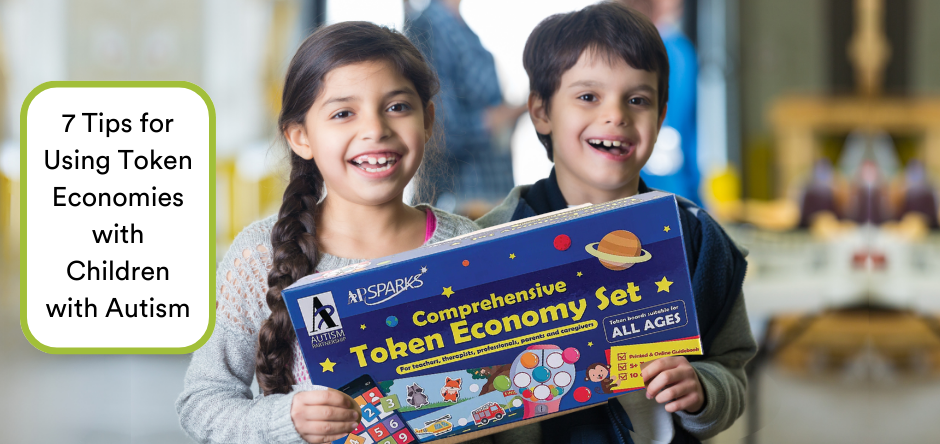
Token economies are structured reinforcement systems used with people across many different populations. They can be particularly useful for reinforcing behaviors and skills in children with autism and other neurodevelopmental differences.
A token economy works similarly to our world economy. A child earns tokens for demonstrating various skills and behaviors, which can then be cashed in for preferred items or activities. Token economies have a significant degree of individualization, making them highly effective at modifying behaviors.
Getting Started
Let’s consider the following tips for using token economies with children with autism.
- Focus on one or two skills or behaviors at first
Well-meaning therapists, teachers, and caregivers might create a token economy with several different behaviors targeted. However, when introducing a token economy, you should start with only 1-2 behaviors or skills. This is necessary to help your learner associate earning tokens with specified behaviors. If they receive tokens for many different behaviors throughout the day, it may be more difficult for them to grasp why they are receiving the tokens. To help them make this association, identify the behaviors that are of the highest priority and start with those. As the learner advances and makes progress with their current goals, you can begin incorporating additional behaviors into the token economy. - Individualize the tokens
Tokens can be anything–tallies, stars, poker chips, stickers, or coins, for example. Individualizing the tokens to something the child enjoys can add an extra layer of reinforcement. For example, if you’re using a token board, you might use stickers of objects or characters that your learner enjoys such as vehicles, animals, or cartoon characters. You don’t want your learner to get distracted by and fixated on the tokens either though, so it’s important to consider that when choosing tokens. - Start with continuous reinforcement
Every aspect of your token economy should be individualized, however, it is often most beneficial to start a token economy with continuous reinforcement, then fade to intermittent. This is especially true for children with more limited language skills. As they begin to pair the behavior with the token, you can shift to providing tokens on an intermittent schedule, depending on an assessment of their unique needs. - Provide immediate reinforcement
Reinforcement should immediately follow the target behavior. When the learner demonstrates the target behavior, immediately provide the token and pair it with social praise. Praise should be behavior-specific, labeling exactly what they did to earn the token. - Don’t forget your backup reinforcers!
This one might seem obvious, but backup reinforcers are a common missing piece of token economies. Children may earn tokens throughout the day or week, with no plan built in for cashing them in for something else. Earning the tokens is only one part of a token economy. Make sure prior to implementation that you have a back-up reinforcer menu ready to go, with plans outlined for how many tokens are needed for each item or activity. Incorporate your learner into the planning of this to ensure the backup reinforcers are motivating to them. - Avoid token economies for behaviors that the learner is already motivated to complete
There is much concern and debate on whether token economies and external rewards in general reduce intrinsic motivation. Research has found that external rewards actually increase intrinsic motivation, but only when the person was not already intrinsically motivated to engage in the behavior (LeBlanc, 2004). For example, imagine a child who enjoys sweeping the floor. She willingly sweeps every day, without external reinforcement. Her mother decides to begin paying her for completing this chore. Adding external rewards to a task that she was previously intrinsically motivated by could actually decrease her intrinsic motivation to complete that task. However, if the same child is not intrinsically motivated to brush her teeth, adding external rewards can increase her intrinsic motivation to brush her teeth. Therefore, only target behaviors that the child is not already motivated to engage in. - Monitor success and adjust
Token economies should be continuously evaluated. Monitor your learner’s progress and make adjustments when necessary to ensure continued progress through their personalized goals. With a well-planned and executed token economy, your learner can make socially significant gains in skills and behaviors.
References
Dalphonse, A. (2022, October 12). Token economy: Examples and applications in Aba. Master
ABA. Retrieved May 1st, 2023, from https://masteraba.com/token-economy-2/
Kazdin A. E. (1982). The token economy: a decade later. Journal of applied behavior analysis,
15(3), 431–445. https://doi.org/10.1901/jaba.1982.15-431
LeBlanc, G., 2004. Enhancing Intrinsic Motivation Through The Use of a Token Economy.
About the Author
Ashleigh Evans, MS, is a Board Certified Behavior Analyst. She has been practicing in the behavior analysis field for over 13 years and opened her own independent practice in early 2022. Her experience has been vast across different age groups, diagnoses, and needs. She is passionate about improving the field through education, reformative action, and better supervisory practices, leading her to create content and resources for families and ABA professionals which can be found on her website, www.evansbehavioralservices.com/.
The post 7 Tips for Using Token Economies with Children with Autism appeared first on Different Roads to Learning Blog.


