

Do you want to just teach skills or teach meaningful responses?
Many ABA practitioners and parents struggle to generalize learned skills, whether to parents or other people, to school, community or natural environments. Sometimes they question — will this child ever really learn this behavior? I mean, REALLY do this behavior. Like when it actually counts?!?!
One of the first clients I have ever worked with transferred from another provider. He had received intensive ABA programming for 2 years. He had already acquired a number of skills — colors, numbers, letters, matching, categorization, even self-help skills. Yet, nothing was functional. If the question wasn’t given in the same format (e.g., touch this, where’s red, wash hands) he would not demonstrate the skill. He lacked the ability to generalize to the natural environment…where it actually counted! It led me to ask myself….
- Does ABA just create robots? Am I creating a robot? Are all of the responses just rote? When should the behavior occur? Does it?
- Will this individual’s ABA program result in being able to join a typical classroom?
- Will this child recognize his hands are dirty and wash them with complete independence?
- Will this child respond to greetings when in the community with someone she’s never seen before?
- Will this child interact with their peers when no trainer is present?
- Will all of these skills being targeted actually result in a meaningful way?
“ABA is not a commodity, but a whole treatment process designed to address all aspects of a child’s life, ultimately improving the overall quality. Generalization should be viewed as an active process of ‘skills learning’ which also requires a systematic approach to teaching.”
Brenda Terzich-Garland, author and creator of The R.E.A.L. Model.
All of these questions can be answered in the new book, The R.E.A.L. Model, Rethinking Generalization: A Practitioner’s Guide to Teach for Generalization in ABA Treatment for Autism and Other Disabilities.
Here are some take home points:
- We live in an ever changing world, you need to program for this. The R.E.A.L. Model sets up a very practical way to plan for generalization.
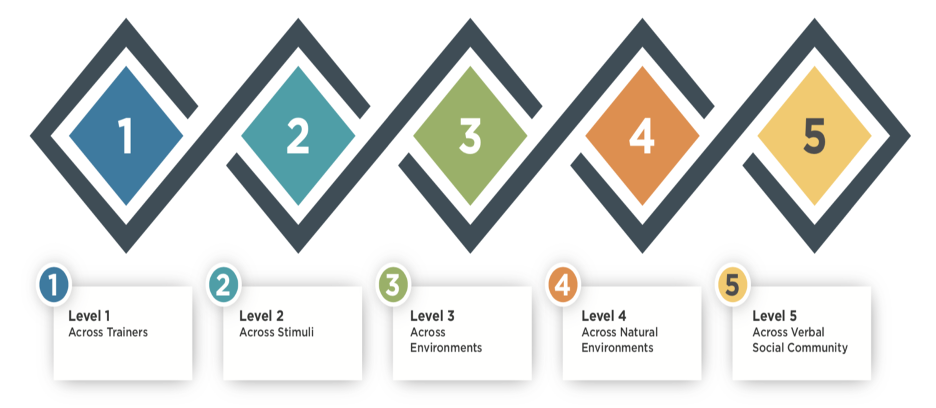
- You must plan for Generalization across trainers, stimuli, environments and to the verbal community. The R.E.A.L. Model gives you a systematic way to plan for generalization in a simple step by step manner, across five unique levels of generalization. Each level has specific guidelines,
- You must plan for Generalization systematically and from the very start of programming. The R.E.A.L. Model focuses on Case Formulation within the Assessment Process, as well as a unique Real Matrix to plan for generalization throughout ABA programming.
Sometimes we do not know what we are missing, simply because we have not been exposed to something. The R.E.A.L. Model is this exact reference. Pick up a copy today to forever change your programming to be more efficient and create more flexibility and adaptivity across all programs!
WRITTEN BY MARI UEDA-TAO, MA, BCBA
Mari is the Chief Clinical Officer for Applied Behavior Consultants, Inc. (ABC) CA. Working in the field of ABA for almost 20 years with students with Autism Spectrum Disorders and other developmental delays, Mari has worked across ten different countries, spreading Behavior Analysis globally.
The post Teach For Generalization With The R.E.A.L. Model! appeared first on Different Roads to Learning Blog.


