

Description
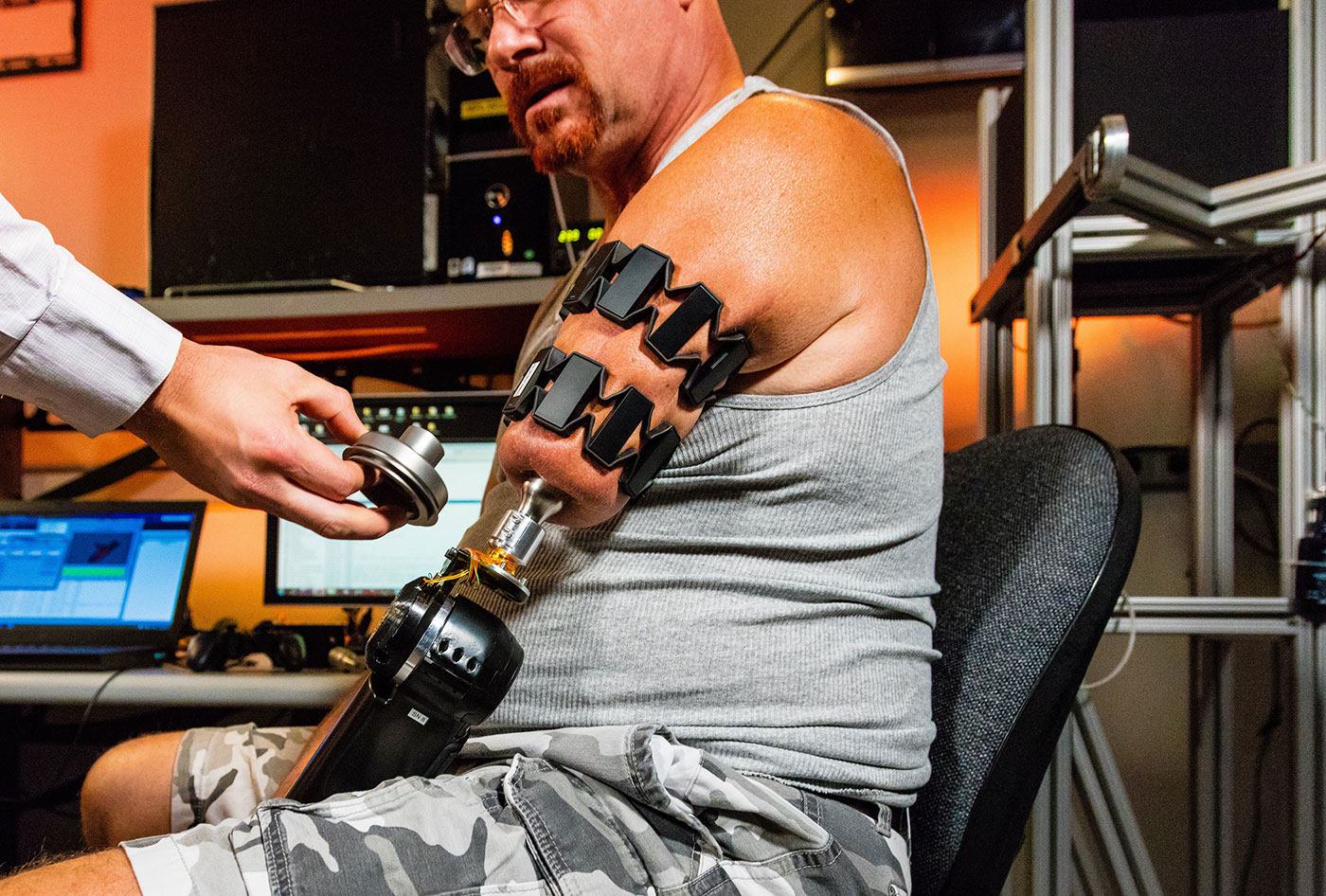
In the past, we have seen quite a few instances where people have been able to control their prosthetics with just their thoughts. Recently, a team of researchers at Johns Hopkins used the Myo armband on an amputee to help him control his prosthetic arm with his mind. The Myo armband is a $199 band that anyone can wear on their arm to control devices. When a person wearing it makes a gesture, the armband recognizes it by reading muscle activity and sends the gesture to a connected device.
Johnny Matheny, who lost one of his arms to cancer, is the subject of this research. He wears two Myo armbands that monitor his muscle activity on his upper arm when he thinks of moving his arm in different ways (twist, grip, open, close, etc.), converts them into signals, transmits them to a computer nearby which in turn sends them to the prosthetic arm to perform the desired action. In the future, it is expected that Johnny may be able to tell how hard or soft an object is, or even the temperature of it.
This is not a very straightforward process though. Johnny had to get surgery done first to rearrange nerves from his missing arm. After the surgery and getting the prosthetic fit, he spent thousands of hours training his mind and doing a lot of mental exercises to work with the prosthetic arm. However, his efforts have paid off so far. He says what he is a part of is like being on the first plane by Wright Brothers, but in the future, with more research and advancement, we will get to the Maserati of prosthetics.
Watch the video below to see Johnny Matheny work his prosthetic arm.
Interested in knowing more about the Myo armband? Watch this quick video.
Source: Assistive Technology Blog
Related Feed Entries
Part 1: Why Great Clinicians Can Struggle as Supervisors
by: Cheryl Davis, PhD, BCBA-D, Dana Reinecke, PhD, BCBA-D
Clinical expertise does not automatically translate into supervisory expertise. Supervisors need explicit instruction, modeling, practice, feedback, and ongoing support, just like…
12 days ago · From Different Roads to Learning
Starting April 1, disabled people across England will be able to travel by bus for free at any time of day. Previously, free bus passes were restricted to off-peak hours on weekdays (between 09:30 and 23:00), making it difficult for pass holders to commute to standard morning jobs or attend late-nig…
01.09.2026 · From Assistive Technology Blog
Fallbrook artist Joel Anderson, “The Artist of Smiles,” has his dog portraits on display at TERI Campus of Life in San Marcos through October 2026.
By Debra Muzikar
Last week I had the pleasure to assist Fallbrook artist Joel Anderson in hanging his dog series art outside Teri’s Co…
25.08.2026 · From The Art of Autism
This list is meant as a springboard for discussion and more awareness into the female experience with autism.
By Samantha Craft
Females with Autism: An Unofficial List
Section A: Deep Thinkers
A deep thinker
A prolific writer drawn to poetry
*Highly intelligent
Sees things at multiple levels, incl…
24.08.2026 · From The Art of Autism
The Biology of Breaking
By Jessica Penot
An autistic meltdown is an involuntary loss of behavioral, emotional, and physiological regulation that occurs when an autistic person’s ability to cope with sensory, cognitive, emotional, or environmental demands is exceeded. Unlike a temper tantrum, a meltd…
19.08.2026 · From The Art of Autism
Rate
Info

Recommend

