

“She won’t say hi unless I say ‘Say Hello.’” “He will only wash his hands if I put his hand on the knob to turn on the water.” “He won’t use his fork until I put it in his hand.”
I hear statements like this all the time from both parents and providers working with learners what autism. What they are describing is “prompt dependence,” which is when a learner requires a prompt from a teacher or parent in order to complete a task. So how do you avoid prompt dependence with your own learners?
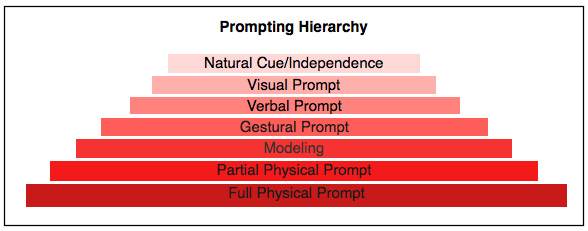
Let’s start with the prompt itself. There are many different ways to prompt which can be divided into levels by how intrusive the prompt is. Below is a sample of a prompt hierarchy, with the least intrusive prompt at the top and the most intrusive prompt at the bottom. Your goal is to quickly move through the prompt levels to move your learner to independence.
Now let’s look at two different examples to show these prompt levels. In the first example, the goal is for the learner to greet a person who walks into the room. In the second example, the goal is for the learner to pull up his/her pants after using the bathroom as a part of a toileting routine.
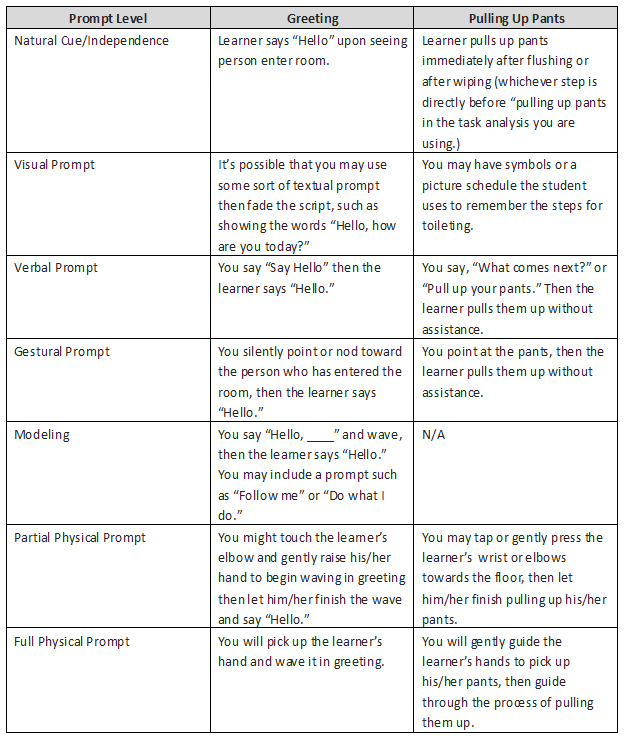
Research shows that least-to-most prompting increases the potential for errors and slows down the rate of acquisition for new skills. Therefore,most-to-least prompting is preferred for teaching new skills. This means that you would start at a full physical prompt and then move your way up the prompt hierarchy until your learner achieves independence with the task.
In the past, when working with discrete trials, it has been common practice to have a learner master a skill at a certain prompt level, then move to a less intrusive prompt and have the learner master the skill at that prompt level, steadily moving towards independence. This can actually encourage prompt dependence because the learner remains on the same prompt level for too long.
Instead, you should try to quickly move up the prompt hierarchy in a way that makes sense for the skill you are trying to teach. Below are some tips to help you help your learners achieve independence.
- Follow the rule of three: Whether you are teaching with discrete trials or in the natural environment, once your learner has successfully responded to a demand three times consecutively, move to a less intrusive prompt.
- If you are taking data, make a notation of what prompt level you are using at each step. (And remember, that only independent responses should be counted towards the learner’s percentage of correct responses.)
- At the end of a session or group of trials, note what prompt level you were at by the end of the session. Then start at that level during the next session.
- If your learner does not respond correctly when you move to a less intrusive prompt, then move back to the most recent prompt level. Once they respond again correctly at that prompt level three times consecutively, move again to a less restrictive prompt.
- Remember that verbal prompts are very difficult to fade. Though they are less intrusive, you should avoid using them when possible.
- You can pair prompts and then fade out the more intrusive prompts. For example, with the sample of pulling up pants described above, you can pair a visual prompt with a gestural prompt by showing the symbol for pulling up pants while pointing at the pants. Over time, you stop using the symbol and just use the gestural prompt. The gestural prompt can be faded by moving your point further and further away from the pants.
- Write down what the prompt levels will look like for the specific task you are teaching. This way you will be fully prepared to quickly move your learner towards independence.
- Differentiate your reinforcement! If you move to a less intrusive prompt and the learner responds correctly, then you should immediately provide a stronger reinforcer than you did for previous responses. If a learner spontaneously responds without a prompt, you should do what I call “throwing them a party” by combining reinforcers (such as tickles and high fives) or providing a highly desirable reinforcer.
Prompting can be very difficult to do well, but following these tips should help set your learner on the path to independence.
WRITTEN BY SAM BLANCO, PhD, LBA, BCBA
Sam is an ABA provider for students ages 3-15 in NYC. Working in education for twelve years with students with Autism Spectrum Disorders and other developmental delays, Sam utilizes strategies for achieving a multitude of academic, behavior, and social goals. She is also an assistant professor in the ABA program at The Sage Colleges.
The post How to Avoid Prompt Dependence in Teaching Students with Autism appeared first on Different Roads to Learning Blog.


