

As adults, we’re fairly accustomed to contracts for car loans, new employment, or updates to our smartphones. But contracts can also be beneficial in the classroom setting. A contingency contract is defined as “a mutually agreed-upon document between parties (e.g., parent and child) that specifies a contingent relationship between the completion of specified behavior(s) and access to specified reinforcer(s)” (Cooper, Heron, & Heward, 2007). There are several studies that indicate using a contingency classroom can be beneficial in the classroom setting.
Cantrell, Cantrell, Huddleston, & Wooldridge (1969) identified steps in creating contingency contracts:
Interview the parent or guardian of the student.
This allows you to work together to identify problem behaviors to be addressed, identify the contingencies currently maintaining these behaviors, determine the child’s current reinforcers, and establish what reinforcement or punishment procedures will be used.
Use this information to create a clear, complete, and simple contract.
The authors provide examples of how these contracts might look. You can vary the contract based upon the behaviors you are addressing with your student and the student’s ability to comprehend such contracts.
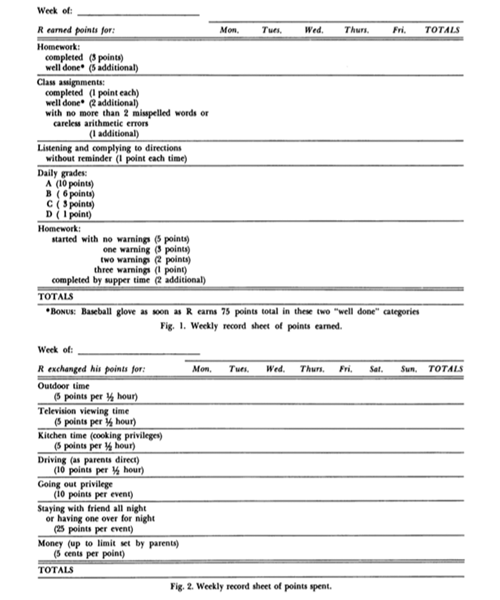
Build data collection into the contract itself.
You can see an example from the article below. For this example, it is clear how points are earned and how the child can utilize those points, and the contract itself is a record of both the points and the child’s behaviors.
There are clear benefits to utilizing such contingency contracting: building relationships across different environments in which the student lives and works, addressing one or more challenging behaviors simultaneously, and providing opportunities for students to come into contact with reinforcement. You can read the entire article here:
Cantrell, R. P., Cantrell, M. L., Huddleston, C. M., & Wooldridge, R. L. (1969). Contingency contracting with school problems. Journal of Applied Behavior Analysis, 2(3), 215-220.
And much more has been written about contingency contracting. If you’d like to learn more, we suggest taking a look at one or more of the following:
Bailey, J. S., Wolf, M. M., & Phillips, E. L. (1970). Home-based reinforcement and the modification of pre-delinquent’s classroom behavior. Journal of Applied Behavior Analysis, 3(3), 223-233.
Barth, R. (1979). Home-based reinforcement of school behavior: A review and analysis. Review of Educational Research, 49(3), 436-458.
Broughton, S. F., Barton, E. S., & Owen, P. R. (1981). Home based contingency systems for school problems. School Psychology Review, 10(1), 26-36.
Miller, D. L., & Kelley, M. L. (1991). Interventions for improving homework performance: A critical review. School Psychology Quarterly, 6(3), 174.
Follow us on Facebook and Instagram to stay caught up our guest blog posts!
WRITTEN BY SAM BLANCO, PhD, LBA, BCBA
Sam is an ABA provider for students ages 3-15 in NYC. Working in education for twelve years with students with Autism Spectrum Disorders and other developmental delays, Sam utilizes strategies for achieving a multitude of academic, behavior, and social goals. She is also an assistant professor in the ABA program at The Sage Colleges. You can read more of Sam’s posts for Different Roads To Learning by clicking here!
The post How To Use Contingency Contracts in the Classroom appeared first on Different Roads to Learning Blog.


