

Description
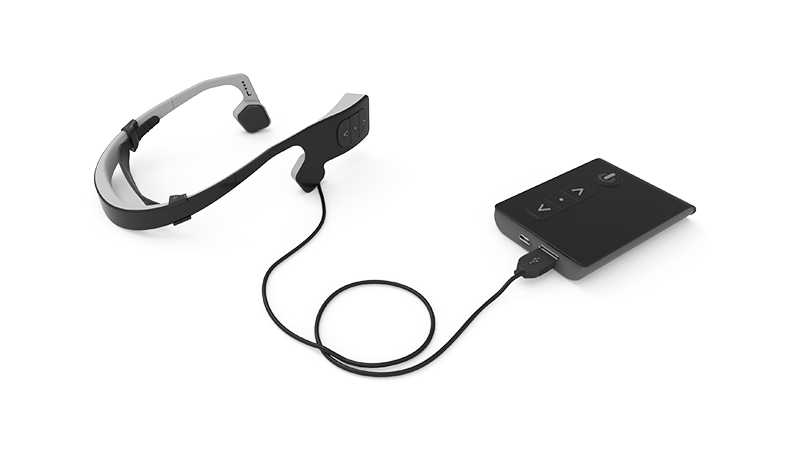
We are probably familiar with many types of wearables - the ones we wear on our wrists that can track activities and provide notifications. There is another wearable under development that can be used like a personal assistant by blind people and can help them navigate their environment as well as make day to day life much easier.
Horus can be used for reading text, object identification, mobility assistance and face recognition. A person can interact with it either through voice or by pressing some simple buttons and giving commands. Horus keeps observing and learning from its surroundings, and adapts to different situations of everyday life.
It is a bone conducting device that is meant to be worn like a headset. The "Horus Eyes" are connected to a small accessory that has the battery and processor that processes all the visuals that Horus Eyes are receiving. that consist of two sensors that detect and perceive the immediate environment in 3D. The bone conducting aspect of it sends sound signals through the bones instead of ear canals, which means that if someone has hearing issues related to the external ear, Horus will totally bypass that.
Watch the following video to see how Horus works and can help people with visual impairment.
Horus is still in the prototype stage so cost at this time is undetermined. However, it is expected to be launched in the second half of 2016.
Check out their website for more information and to sign up for their newsletter!
Source: Assistive Technology Blog
Related Feed Entries
Part 1: Why Great Clinicians Can Struggle as Supervisors
by: Cheryl Davis, PhD, BCBA-D, Dana Reinecke, PhD, BCBA-D
Clinical expertise does not automatically translate into supervisory expertise. Supervisors need explicit instruction, modeling, practice, feedback, and ongoing support, just like…
12 days ago · From Different Roads to Learning
Starting April 1, disabled people across England will be able to travel by bus for free at any time of day. Previously, free bus passes were restricted to off-peak hours on weekdays (between 09:30 and 23:00), making it difficult for pass holders to commute to standard morning jobs or attend late-nig…
01.09.2026 · From Assistive Technology Blog
Fallbrook artist Joel Anderson, “The Artist of Smiles,” has his dog portraits on display at TERI Campus of Life in San Marcos through October 2026.
By Debra Muzikar
Last week I had the pleasure to assist Fallbrook artist Joel Anderson in hanging his dog series art outside Teri’s Co…
25.08.2026 · From The Art of Autism
This list is meant as a springboard for discussion and more awareness into the female experience with autism.
By Samantha Craft
Females with Autism: An Unofficial List
Section A: Deep Thinkers
A deep thinker
A prolific writer drawn to poetry
*Highly intelligent
Sees things at multiple levels, incl…
24.08.2026 · From The Art of Autism
The Biology of Breaking
By Jessica Penot
An autistic meltdown is an involuntary loss of behavioral, emotional, and physiological regulation that occurs when an autistic person’s ability to cope with sensory, cognitive, emotional, or environmental demands is exceeded. Unlike a temper tantrum, a meltd…
19.08.2026 · From The Art of Autism
Rate
Info

Recommend

