

Description

This post is meant to be thought provoking. Please share your thoughts & feedback in the comments section below.
We live in a world that is inventing assistive technology solutions constantly. There are all sorts of devices, accessories, apps, and wearables that are inexpensive, yet provide great convenience to people with disabilities. Technology is amazing, and with access to all sorts of resources on the internet, inventing assistive technology solutions and reaching out to more and more people is becoming more common. Three or four decades ago, would we have ever imagined that assistive technology would take such huge leaps?
The present is fantastic. Now..let's look into the future. How crazy can things get in the future?
Imagine a world where someone doesn't need to use any devices. Even though they may have disabilities, they will be able to go about doing their daily chores without the help of assistive technology.
How would that be possible though?
Bio Hacking!
By including chips in our body - chips that will hold and transfer different types of information and perform various functions for us. Picture a blind person wanting to open a door that has electronic lock - instead of looking for their key fob in their pocket and then flashing it in front of the lock, the person just stands in front of the lock (or waves their hand in front of it) and the door unlocks. The same person could be at a check out counter at a grocery store ready to pay. The same chip (or a different one) embedded in their body that stores their credit card information could be read by the card scanner/machine without the person doing anything (reaching out for their wallet and pulling out cash/ credit card). When it's time to go back home, a chip that has GPS co-ordinates to their house, will give them step by step directions. Once you enter your home, the thermostat would set to a specific temperature, and the oven would start.
If someone requires frequent visits to the doctor, a similar chip in their body can eliminate or reduce visits by monitoring all their biomedical information over a period of time, and transmitting it to the doctor via Bluetooth and internet. Messages and text messages could be displayed on a screen embedded in their skin. Imagine how helpful that would be for someone that muscular dystrophy, ALS or limited motor skills, and pulling out a phone out of their pocket is a really tedious task.
Embedding tiny magnets in your fingertips will be able to give the person a sort of sixth sense - they would be able to detect magnetic fields around them. By just waving their hand in a room, they can get a sense of where things are, and also get some additional information like the shape of the objects. They would possibly be able to lift small objects with those embedded magnets.
Essentially, with the help of electronics and technology, our bodies would be enhanced and be able to do things that a "regular" body cannot do on its own.
What is the inspiration behind this crazy vision though?
First of all, depending on who you talk to, it may or may not be considered crazy. A lot of "Body
hacking" or "Bio hacking" is already being done by many body hackers, whose aim is to enhance the way the human body functions. They believe in running faster than a cheetah, smashing holes through walls, avoiding feeding the body because of hunger! Okay, these are definitely crazy ideas but their basic philosophy is that with a few tweaks, the human body can do a lot more than what we are used to.
hacking" or "Bio hacking" is already being done by many body hackers, whose aim is to enhance the way the human body functions. They believe in running faster than a cheetah, smashing holes through walls, avoiding feeding the body because of hunger! Okay, these are definitely crazy ideas but their basic philosophy is that with a few tweaks, the human body can do a lot more than what we are used to.
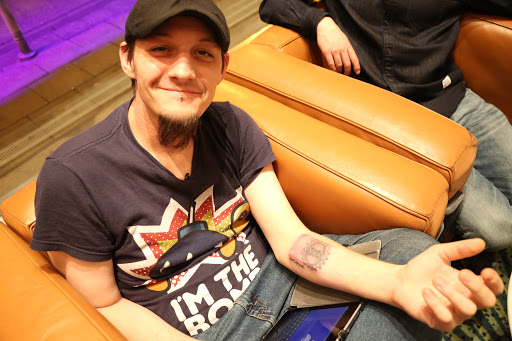 |
| Tim Cannon |
We may think that all of this will happen anywhere from 10 - 70 years from now, but, the reality is that all of this has already started happening. This phenomenon is off to a start in a sort of an underground, not so mainstream, traditional community. However, keep an eye on this space because within the next few years, it has potential to get noticed by more and more bigger companies who wouldn't hesitate to make this more mainstream.
Do we question the feasibility of body hacking? We did question the personal computer and cell phones when they first came out too.
Inspiration: The Big Picture With Kal Penn: Body City
Additional Sources: The Verge, Tech Insider
Grindhouse Wetware videos
Additional Sources: The Verge, Tech Insider
Grindhouse Wetware videos
Source: Assistive Technology Blog
Related Feed Entries
Part 1: Why Great Clinicians Can Struggle as Supervisors
by: Cheryl Davis, PhD, BCBA-D, Dana Reinecke, PhD, BCBA-D
Clinical expertise does not automatically translate into supervisory expertise. Supervisors need explicit instruction, modeling, practice, feedback, and ongoing support, just like…
12 days ago · From Different Roads to Learning
Starting April 1, disabled people across England will be able to travel by bus for free at any time of day. Previously, free bus passes were restricted to off-peak hours on weekdays (between 09:30 and 23:00), making it difficult for pass holders to commute to standard morning jobs or attend late-nig…
01.09.2026 · From Assistive Technology Blog
Fallbrook artist Joel Anderson, “The Artist of Smiles,” has his dog portraits on display at TERI Campus of Life in San Marcos through October 2026.
By Debra Muzikar
Last week I had the pleasure to assist Fallbrook artist Joel Anderson in hanging his dog series art outside Teri’s Co…
25.08.2026 · From The Art of Autism
This list is meant as a springboard for discussion and more awareness into the female experience with autism.
By Samantha Craft
Females with Autism: An Unofficial List
Section A: Deep Thinkers
A deep thinker
A prolific writer drawn to poetry
*Highly intelligent
Sees things at multiple levels, incl…
24.08.2026 · From The Art of Autism
The Biology of Breaking
By Jessica Penot
An autistic meltdown is an involuntary loss of behavioral, emotional, and physiological regulation that occurs when an autistic person’s ability to cope with sensory, cognitive, emotional, or environmental demands is exceeded. Unlike a temper tantrum, a meltd…
19.08.2026 · From The Art of Autism
Rate
Info

Recommend

