

By: Stephanny Freeman, PhD and Kristen Hayashida, MEd, BCBA. Their new book: “Executive Function in the Early Childhood Classroom” can be purchased HERE
When kindergarten teachers are asked what skills they would like their students to have the beginning of the year, their answers might be surprising! Parents and caregivers are often concerned with making sure their children can say their ABC’s, count to 10, and know their colors. Some may believe that their children should be reading by the time they start kindergarten. However, kindergarten teachers often have a different set of priorities, and instead are looking for skills such as:
- The ability to listen to and follow directions
- Follow classroom routines
- Control impulses
- Resolve a conflict or solve a problem calmly with another child
Kindergarten teachers value these skills because they are critical for school readiness, paving the way for children to be academically and socially successful. Moreover, children who are behind in these skills can require disproportionate amounts of teachers’ attention, derail classroom activities and routines, and interfere with other children’s learning.
Underlying these school readiness skills are a set of higher order thinking skills collectively referred to as Executive Functions (EFs). EFs are the cognitive control functions that help us inhibit our initial impulses and think before acting.
But while most teachers agree that EF skills are very important, they are not explicitly taught in most early education settings (or at any point in most children’s educational experiences).
What skills are part of executive functioning?
Three key skills are generally agreed upon as the core of EF:
- Working memory: holding information in mind to manipulate, work with, or act on at a later time.
- Inhibitory control: the ability to regulate one’s attention, behavior, thinking, and emotion particularly in response to distractions or temptations.
- Cognitive flexibility: the capacity to shift one’s thinking, such as changing one’s approach to solving a problem if the previous approach is not working or recognizing and responding when the demands of that task have changed.
Seven additional skills are also considered to fall under the umbrella of EF, often relying and building on the three foundational EF skills:
- Initiation: the ability to begin a task or activity or to generate ideas independently in order to answer questions, solve problems, or respond to environmental demands.
- Fluency: how fluidly one can access and use relevant knowledge or skills.
- Planning: the ability to identify and sequence all the different steps needed to achieve a specific goal.
- Organization: the capacity to prioritize and make decisions about which tasks to undertake, and the needed resources to complete those tasks.
- Problem solving: carrying out the steps to achieve a desired goal, while monitoring progress making necessary adjustments.
- Time awareness: part of the broader skill of Time Management, which includes to the ability to anticipate how long tasks might take, to be aware of time constraints, track one’s progress, and adjust one’s behavior in order to complete tasks efficiently.
- Emotion regulation: skills including identifying one’s own emotion states and responding appropriately to emotional experiences.
Why do executive function skills matter?
Executive function skills predict a host of short-term and long-term outcomes!
- They are a stronger predictor of school readiness than IQ.
- They are also associated with higher achievement in both reading and math throughout children’s schooling.
- EF skills, when tested in early childhood predict outcomes later in childhood and adolescence, including psychological and physical health.
Because EF skills are so predictive of later outcomes, they are being increasingly recognized as a critically important focus of intervention.
“Early EF training is … an excellent candidate for leveling the playing field and reducing the achievement gap between more- and less-advantaged children.”
Diamond and Lee (2011, p. 6)
Can executive function skills improve?
Yes! All young children (typically developing and those with difficulties) can benefit greatly from instruction in EF! Frequent practice of these skills and gradually raising the difficulty benefits children most in generalization and increasing gains. Practitioners and parents should consider:
- Providing focused instruction in EF skills.
- Combining explicit targeted instruction in EF skills with other activities in which they can then apply and practice those skills.
- Building targeted EF skills into daily routines.
- Providing multiple opportunities every day, particularly for children with disabilities, to test out and practice EF skills.
“Most experts consider the development of self-regulation skills, of which executive functions are the crown jewel, to be the most important objective of high quality preschool—to help children focus attention, be emotionally expressive, not be impulsive, and to engage in purposeful and meaningful interactions with caregivers and other children”
Blair (2017, p.4)
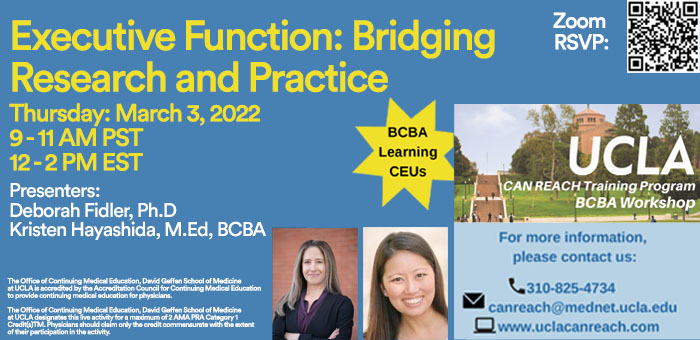
About The Authors
Dr. Stephanny Freeman is a clinical professor at UCLA, a licensed clinical psychologist, and Co-Directs the Early Childhood Partial Hospitalization Program (ECPHP). For 20 years, she has educated children with ASD and other exceptionalities as a teacher, studied interventions for social emotional development, and designed curriculum and behavior plans in school and clinic settings.
Kristen Hayashida is a Board Certified Behavior Analyst at the UCLA Early Childhood Partial Hospitalization Program (ECPHP). For the last 10 years she has served as a therapist, researcher and educator of children and families living with autism spectrum disorder through the treatment of problem behavior.
The post A Spotlight On: “Executive Function in the Early Childhood Classroom” appeared first on Different Roads to Learning Blog.


