

Description
When it comes to communicating via email or text messaging, deaf people have to rely on English or other language keyboards even though sign language may be their primary language. Although deaf people read, write and lip read in their surrounding language, sign language can be independent of that. Also, there are different rules for forming well structured sentences in sign language. If native language keyboards don’t work, deaf people use videos to communicate with one another.
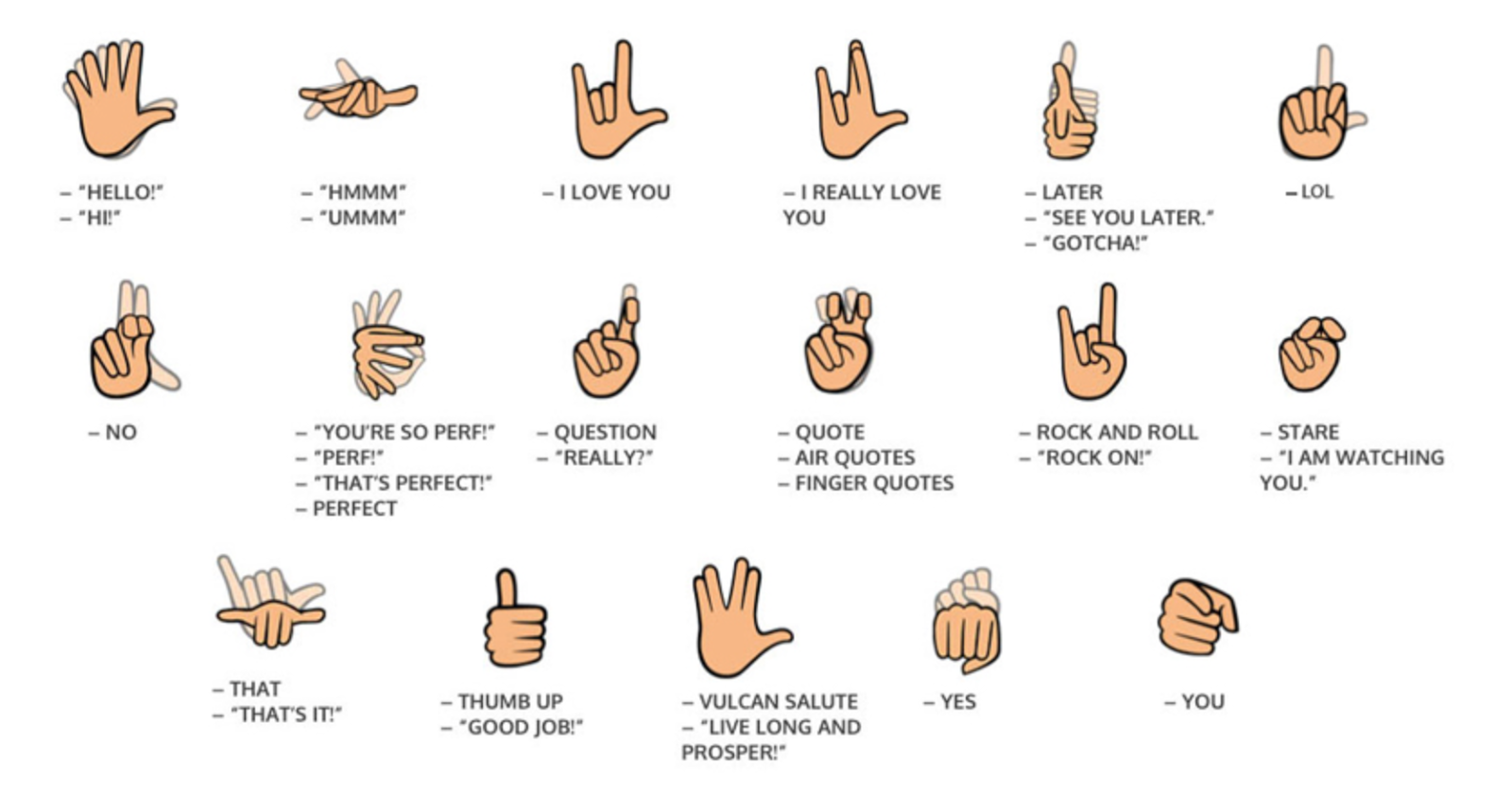
To provide the independence and joy of communicating in sign language over email and text, ASLized!, a non profit organization that creates educational videos in ASL, has created an ASL keyboard. This keyboard, available on iOS and Android for 99 cents, has a QWERTY style keyboard that lists the alphabet, numbers from 0 - 31 and various other sentences and phrases in the form of gif/emoji style icons. A user forms their sentence by just choosing those emojis and sending them off in a message! It makes communication for them much quicker and natural. If need be, users can use a combination of ASL and words in surrounding language to communicate.Signily also has various skin tones representing different ethnicities.
We know that day to day life can be much more fun and casual with some profanity (*wink*), and signily has some emojis for profanity in ASL! However, there is a profanity free option as well for users who like to keep their conversation clean.
Here's an example of what texting via Signily looks like:
Go to the website to learn more about Signily. They also have a great (and super quick) tutorial that shows how to use it.
Source: Tech Insider
Source: Assistive Technology Blog
Related Feed Entries
Part 1: Why Great Clinicians Can Struggle as Supervisors
by: Cheryl Davis, PhD, BCBA-D, Dana Reinecke, PhD, BCBA-D
Clinical expertise does not automatically translate into supervisory expertise. Supervisors need explicit instruction, modeling, practice, feedback, and ongoing support, just like…
9 days ago · From Different Roads to Learning
Starting April 1, disabled people across England will be able to travel by bus for free at any time of day. Previously, free bus passes were restricted to off-peak hours on weekdays (between 09:30 and 23:00), making it difficult for pass holders to commute to standard morning jobs or attend late-nig…
01.09.2026 · From Assistive Technology Blog
Fallbrook artist Joel Anderson, “The Artist of Smiles,” has his dog portraits on display at TERI Campus of Life in San Marcos through October 2026.
By Debra Muzikar
Last week I had the pleasure to assist Fallbrook artist Joel Anderson in hanging his dog series art outside Teri’s Co…
25.08.2026 · From The Art of Autism
This list is meant as a springboard for discussion and more awareness into the female experience with autism.
By Samantha Craft
Females with Autism: An Unofficial List
Section A: Deep Thinkers
A deep thinker
A prolific writer drawn to poetry
*Highly intelligent
Sees things at multiple levels, incl…
24.08.2026 · From The Art of Autism
The Biology of Breaking
By Jessica Penot
An autistic meltdown is an involuntary loss of behavioral, emotional, and physiological regulation that occurs when an autistic person’s ability to cope with sensory, cognitive, emotional, or environmental demands is exceeded. Unlike a temper tantrum, a meltd…
19.08.2026 · From The Art of Autism
Rate
Info

Recommend

