

Description
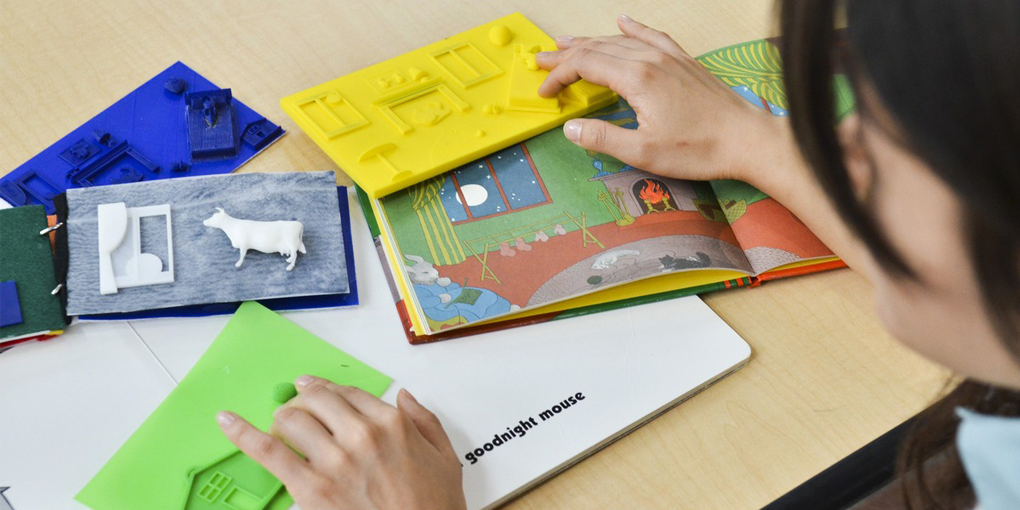
Every child, one way or the other, sooner or later, starts to read stories from children's books. These books are short and sweet, introduce children to objects around them, and help them understand a lot of important concepts at a very early age.
But how would a blind or visually impaired child learn from such books?
To help children with visual impairment have the same learning experience, a team at University of Colorado has started a new project called "Tactile Pictures Book Project" that prints children's books on a 3D printer and raises all the images, so the children can feel them with their hands and understand what the objects are. These images have good detail, and are almost exactly the same as their 2-dimensional printed counterparts. The accompanying text is printed in Braille so the children can also read along with feeling the images.
However, children's books have a lot more than just a combination of static images and texts. Some of these books are much more interactive - they have flaps that open and close to reveal other items underneath, feature other objects that move, spin, swing and can be pushed and pulled to teach various concepts and techniques to children. Can all of that be done with a 3D printer?
Absolutely. The software can imitate everything that the printed book has and 3D print the same features, thus making the experience for the blind child very much the same. The team is also working on 3D printing comic books and textbooks in a similar way.
Make sure to watch the video here to know what the 3D printed children's book look like. It also shows all the interactive parts.
Visit their websiteand subscribe to their newsletter to learn more about this project! If you have a 3D printer, you can also download the project files for some of these books from their website and print them yourself.
Image source: Mashable
Source: Assistive Technology Blog
Related Feed Entries
Starting April 1, disabled people across England will be able to travel by bus for free at any time of day. Previously, free bus passes were restricted to off-peak hours on weekdays (between 09:30 and 23:00), making it difficult for pass holders to commute to standard morning jobs or attend late-nig…
5 days ago · From Assistive Technology Blog
Fallbrook artist Joel Anderson, “The Artist of Smiles,” has his dog portraits on display at TERI Campus of Life in San Marcos through October 2026.
By Debra Muzikar
Last week I had the pleasure to assist Fallbrook artist Joel Anderson in hanging his dog series art outside Teri’s Co…
12 days ago · From The Art of Autism
This list is meant as a springboard for discussion and more awareness into the female experience with autism.
By Samantha Craft
Females with Autism: An Unofficial List
Section A: Deep Thinkers
A deep thinker
A prolific writer drawn to poetry
*Highly intelligent
Sees things at multiple levels, incl…
13 days ago · From The Art of Autism
The Biology of Breaking
By Jessica Penot
An autistic meltdown is an involuntary loss of behavioral, emotional, and physiological regulation that occurs when an autistic person’s ability to cope with sensory, cognitive, emotional, or environmental demands is exceeded. Unlike a temper tantrum, a meltd…
19.08.2026 · From The Art of Autism
Living in Full Color
By Mimi Oh
Let’s be brutally honest: Being a Black woman is already hard enough. As part of the overlap of intersectionality, I fully identified as a dark-skinned, cisgender, bi/demisexual,
Catholic, Black-American woman of Nigerian descent, whose culture revolves around the Igb…
18.08.2026 · From The Art of Autism
Rate
Info

Recommend

